The Strategic Pivot: India’s Transformation into a Global Technology Manufacturing Hub
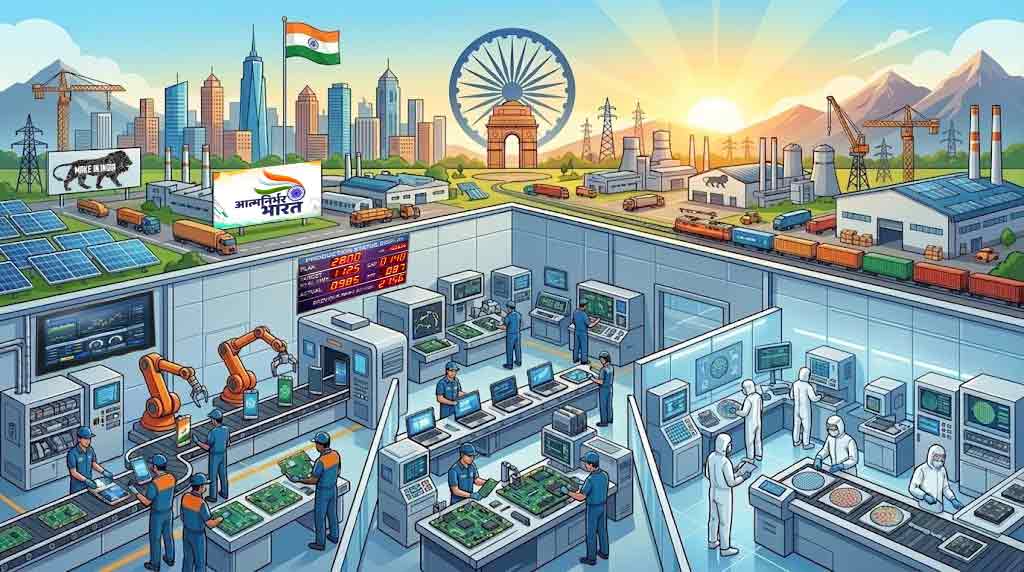
Over the past decade, India has undergone a profound structural shift in its industrial landscape, transitioning from a traditional consumer of imported high-end technology to a burgeoning global manufacturing powerhouse. Driven by the twin pillars of the "Make in India" initiative and the "Atmanirbhar Bharat" (Self-Reliant India) mission, the nation has systematically dismantled barriers to entry for global tech giants while simultaneously fostering a domestic ecosystem capable of complex hardware assembly and component manufacturing.
This industrial metamorphosis is not merely a matter of national pride; it represents a fundamental change in India’s economic trajectory. By incentivizing the localization of supply chains, the government has moved beyond simple assembly lines, pushing for deep-tech integration that spans from semiconductor design and electronics manufacturing to the production of advanced industrial machinery. As global firms look to diversify their manufacturing footprints away from concentrated markets, India has positioned itself as a stable, high-capacity alternative, reshaping the global trade map in the process.
Policy Frameworks and the Infrastructure of Growth
The success of India’s push into high-tech manufacturing rests on a series of aggressive policy interventions designed to lower the cost of doing business. Central to this strategy has been the implementation of Production Linked Incentive (PLI) schemes. These programs provide financial rewards to manufacturers based on incremental sales of products manufactured in domestic facilities. By targeting sectors such as mobile handsets, telecommunications equipment, and lithium-ion batteries, the government has successfully attracted multibillion-dollar investments from international conglomerates.
Beyond fiscal incentives, the transformation has been bolstered by significant investments in physical infrastructure. The modernization of logistics networks—including dedicated freight corridors, expanded port capacity, and the digitization of customs clearances—has drastically reduced the time and expense required to move goods from factory floors to international markets. Furthermore, the focus on "Ease of Doing Business" has simplified regulatory compliance, moving toward a single-window clearance system that allows manufacturers to focus on production efficiency rather than bureaucratic hurdles. This environment has encouraged both multinational corporations and local startups to scale their operations, creating a competitive industrial ecosystem that is increasingly self-sustaining.
Human Capital and the Future of Industrial Employment
The surge in technology manufacturing has had a direct and measurable impact on the Indian labor market. The shift toward high-tech production demands a workforce that is not only skilled in traditional manual labor but also proficient in precision engineering, automated system management, and quality control. In response, the government and private sector have aligned to overhaul vocational training programs, focusing on technical institutes that bridge the gap between academic theory and factory-floor realities.
This transition is creating a new class of industrial jobs that offer higher stability and better remuneration than traditional manufacturing roles. As factories become more digitized, the demand for technicians who can oversee robotics, manage data-driven supply chains, and maintain complex hardware has skyrocketed. This development is effectively creating a robust middle class in industrial hubs, providing a stable economic foundation that supports local services, education, and retail markets. The integration of young, tech-savvy workers into these high-value manufacturing roles is essential for sustaining the momentum of the Atmanirbhar Bharat initiative over the long term.
What This Means for Farmers
While the manufacturing boom may seem removed from the fields, its implications for the agricultural sector are significant and multifaceted. The "Atmanirbhar Bharat" initiative is not limited to consumer electronics; it is increasingly focused on the localization of agricultural machinery and precision farming technology.
1. Access to Affordable Technology: As India builds its own manufacturing base for sensors, automated irrigation controllers, and advanced machinery, farmers can expect a reduction in the cost of importing foreign-made ag-tech. Increased domestic production will likely lead to more competitive pricing for drones, precision seeders, and smart farm management tools.
2. Improved Rural Infrastructure: The industrial development occurring in regional hubs often necessitates improved road, rail, and electricity infrastructure. Farmers operating near these emerging manufacturing corridors stand to benefit from better logistics, reduced post-harvest losses, and more reliable access to power for irrigation and processing facilities.
3. Alternative Employment and Economic Diversification: The rise of new factories provides non-farm employment opportunities for rural households, helping to diversify income streams. This reduces the economic dependence on seasonal harvests and provides a buffer for farm families during periods of climate-induced volatility or market fluctuations.
4. Industrial Linkages: The focus on self-reliance encourages the processing of raw agricultural goods within India. As the manufacturing sector expands, there is a growing opportunity for farmers to integrate into the value chain as suppliers for bio-based industrial materials or as participants in integrated food processing systems, moving beyond the sale of raw commodities to higher-value processed goods.