🌱 What Gujarat Farmers Can Learn from Singapore
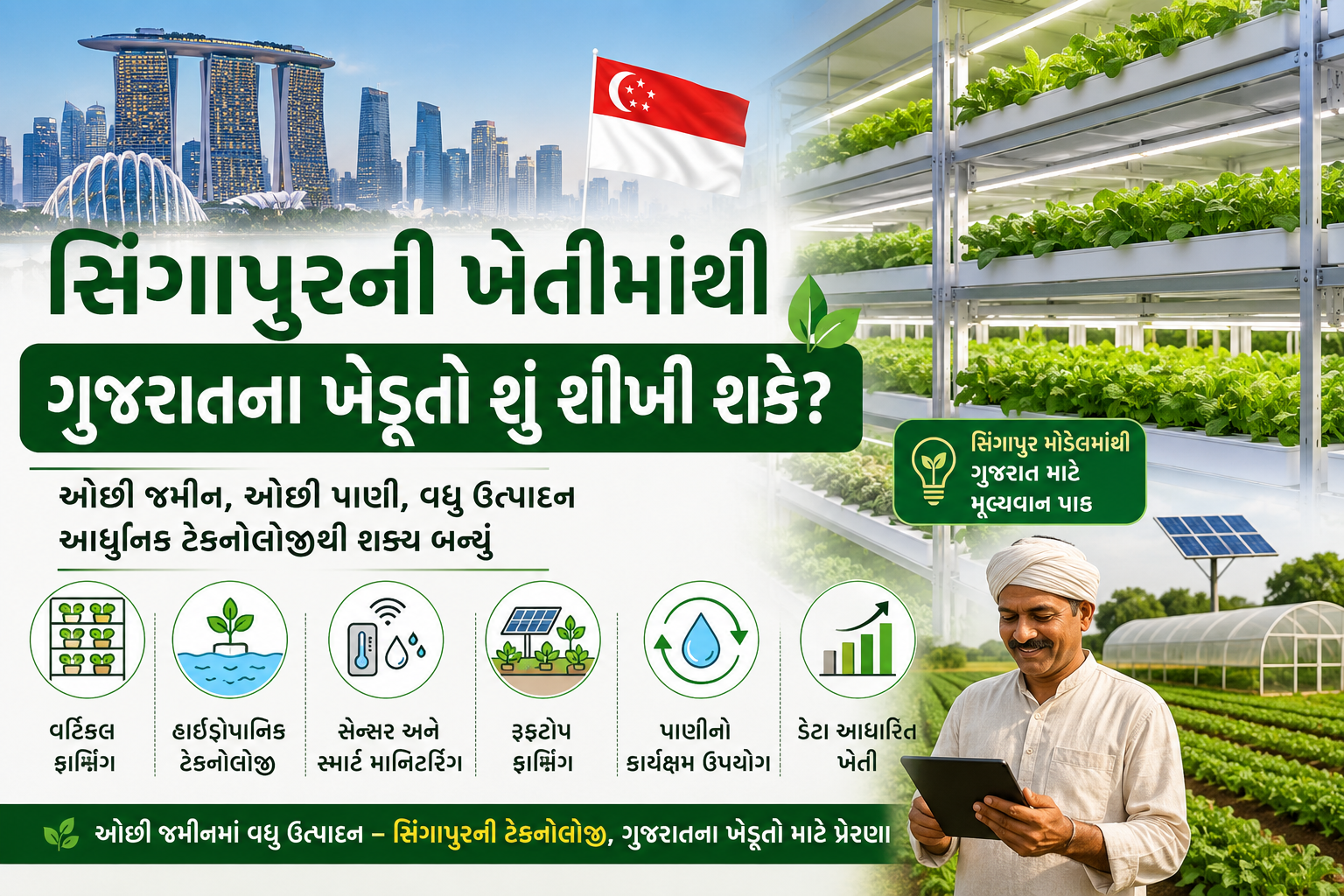
Singapore has limited agricultural land, yet farms are adopting indoor farming, vertical farming, hydroponics, rooftop farming and smart sensors. Gujarat farmers do not need to copy every technology, but the focus on efficient use of water, land, labour and farm data offers useful lessons.
What can Gujarat farmers learn from Singapore farming? Singapore Food Agency describes land-based, indoor and rooftop agriculture. Indoor farms may use vertical or multi-tier systems and recirculating hydroponics. citeturn0search0

🇸🇬 How Is Farming Different in Singapore?
Singapore is a land-scarce country, so efficient use of available space and resources is important. SFA identifies land-based, indoor and rooftop farms. Indoor farms can use vertical or multi-tier systems, artificial lighting and recirculating hydroponics. Rooftop farms can use otherwise underutilised spaces. citeturn0search0
This does not mean Gujarat farmers should immediately build indoor farms. Gujarat and Singapore differ in climate, land, crops, electricity, water and markets. The better approach is to learn the principles and adapt them locally.
🌾 7 Farming Lessons Gujarat Farmers Can Learn from Singapore
1. Use Water Precisely
Match irrigation with crop requirements and monitor water use.
2. Monitor Crops with Sensors
Use useful data such as moisture and temperature to improve decisions.
3. Use Space Efficiently
Consider protected cultivation, nurseries and space-efficient systems where suitable.
4. Make Data-Based Decisions
Record water, fertilizer, costs, production and crop problems.
5. Detect Problems Early
Regular crop scouting can help identify disease and pest symptoms early.
6. Automate Where It Pays
Use automation for irrigation, fertigation or protected cultivation when economics justify it.
7. Test Before Scaling
Run a small pilot, measure costs and output, check market demand and then consider expansion.
💧 What Can Gujarat Learn About Water Management?
Some Singapore farms use hydroponic and controlled growing systems where water and nutrients can be managed precisely. SFA describes hydroponics as a soilless cultivation method using nutrient-rich water. citeturn0search24turn0search2
The practical lesson for Gujarat is not that every farm should become hydroponic. Instead, irrigation can be made more precise through crop-based scheduling, drip irrigation and water monitoring where appropriate.
💧 Water Management Checklist
- Check crop and soil conditions before irrigation.
- Avoid unnecessary over-irrigation.
- Consider drip or micro-irrigation where suitable.
- Check irrigation systems for leakage.
- Keep a simple water and fertilizer record.
📡 Sensors and Smart Farming
Singapore agritech examples include smart sensors that monitor temperature, humidity and light. Some systems can use this information to adjust growing conditions. citeturn0search1
Gujarat farmers do not necessarily need expensive systems. Small useful sensors can be considered for greenhouses, polyhouses, nurseries or high-value crops when the data improves real farm decisions.
📊 Why Farm Data Matters
One important lesson from high-tech farming is data-driven decision making. Recording water, fertilizer, labour, pest and disease observations, production and sales can help farmers understand which practices actually work.
| What to Record | Why | What It Shows |
|---|---|---|
| Water use | Irrigation management | Where and how much water is used |
| Fertilizer cost | Input efficiency | Cost versus output |
| Crop production | Performance comparison | Which practice performed better |
| Pest/disease dates | Crop monitoring | When problems increased |
🛡️ Early Detection of Pests and Diseases
SFA provides resources on pest management and Integrated Pest Management. The broader lesson is to combine monitoring, prevention and appropriate control methods rather than relying only on pesticides. citeturn0search0
For Gujarat farmers, regular crop scouting, early identification of symptoms and advice from recognised agricultural experts can similarly support better crop management.
🏠 What Can Rooftop and Vertical Farming Teach Us?
Singapore rooftop farms use underutilised spaces such as building rooftops and multi-storey carparks. Vertical farming can increase growing area where land is limited. citeturn0search0
In Gujarat, these concepts may be relevant for selected urban farming, nurseries, leafy vegetables, protected cultivation or high-value crops. Structural safety, heat, water, electricity, cooling, investment and market demand must be evaluated first.
🧪 Why Test New Farming Technology First?
Some Singapore farms conduct research and trials before scaling new systems. SFA farm examples describe testing hydroponics, nutrient control, irrigation calibration and sensors before commercial scale-up. citeturn0search4
🧪 5-Step Pilot Plan
- Test the technology on a small area.
- Record water, fertilizer, labour and electricity costs.
- Compare crop growth and production.
- Check market price and potential profit.
- Scale gradually only if results are positive.
⚠️ Why Singapore's Farming Model Should Not Be Copied Directly
Singapore and Gujarat have different agricultural conditions. Singapore has limited land and specialised controlled-environment infrastructure. Gujarat has open-field farming, different climates, crops, water conditions and markets.
The strongest lesson is technology + measurement + efficient resource management. It does not mean every farmer should build a vertical farm.
❌ Mistakes to Avoid Before Buying New Technology
- Do not make a large investment based only on online videos.
- Check crop suitability before buying equipment.
- Do not assume technology automatically means higher profit.
- Calculate water, electricity, labour and maintenance costs.
- Check market demand and selling price before selecting high-value crops.
👨🌾 Where Should a Small Farmer Start?
Smart farming does not always require expensive technology. Farmers can begin with record keeping, irrigation scheduling, crop scouting, soil-moisture observation and cost-versus-production tracking.
🚜 Simple 30-Day Smart Farming Plan
- Keep an irrigation record.
- Inspect the crop systematically every week.
- Save dates and photos when pest or disease symptoms appear.
- Record fertilizer and other input costs.
- Track production.
- Compare cost and income at the end of the season.
🌍 What Does Singapore's 30-by-30 Goal Teach?
Singapore's 30-by-30 goal aims to build the capability to produce 30% of its nutritional needs locally and sustainably by 2030. Technology, innovation and local production are important parts of the strategy. citeturn0search19turn0search7
For Gujarat, the broader lesson is that farming should focus not only on output but also on resource efficiency, climate resilience, food quality and long-term farm planning.
📌 Key Singapore Farming Lessons for Gujarat Farmers
- Use water based on crop needs and measurement.
- Monitor crops regularly.
- Use data where it improves decisions.
- Test new technology on a small scale first.
- Reduce waste of land and water resources.
- Focus on early pest and disease detection.
- Use automation when the economics justify it.
- Do not assume every Singapore technology is suitable for Gujarat.
🔗 Official Information & References
🔗 More Farmer Information on Smart Khedut
👨🌾 Adopt New Farming Technology Wisely
Stay connected with Smart Khedut for modern farming, weather, crop advice, market prices and useful agriculture information.
Explore More Farmer Information❓ Frequently Asked Questions
What can Gujarat farmers learn from Singapore farming?
Farmers can learn about water management, crop monitoring, data-based farming, automation, protected cultivation and small-scale testing of new technology.
What is vertical farming in Singapore?
Vertical farming grows crops across multiple levels or multi-tier systems to use limited growing space efficiently.
What is hydroponic farming?
Hydroponics is a soilless cultivation approach where plants are grown using nutrient-rich water or a soilless growing system.
Can Gujarat farmers use Singapore-style vertical farming?
It may be considered for selected crops and urban or protected farming applications, but local climate, electricity, water, investment and market feasibility should be evaluated first.
Should every farmer install smart farming sensors?
No. Sensors are useful when their data improves farm decisions and the cost is justified.
What should farmers do before adopting new farming technology?
Test it on a small area, record costs and production, check market demand and expand gradually only after positive results.
Can Singapore's farming model be directly copied in Gujarat?
Not completely. Land, climate, crops and economics are different. It is better to learn the technology and resource-management principles and adapt them locally.
🛡️ Sources & Editorial Note
Published By
Smart Khedut Agri-Information Team
Agriculture, Smart Farming & Farmer Information
Reference Sources
- Singapore Food Agency - Agriculture Technologies
- Singapore Food Agency - Agritech in Singapore
- Singapore Food Agency - Hydroponics / Soilless Farming Resources
Not every Singapore farming technology is suitable for every crop or farm in Gujarat. Evaluate local climate, crop, water, electricity, market, cost and expected returns before investing.