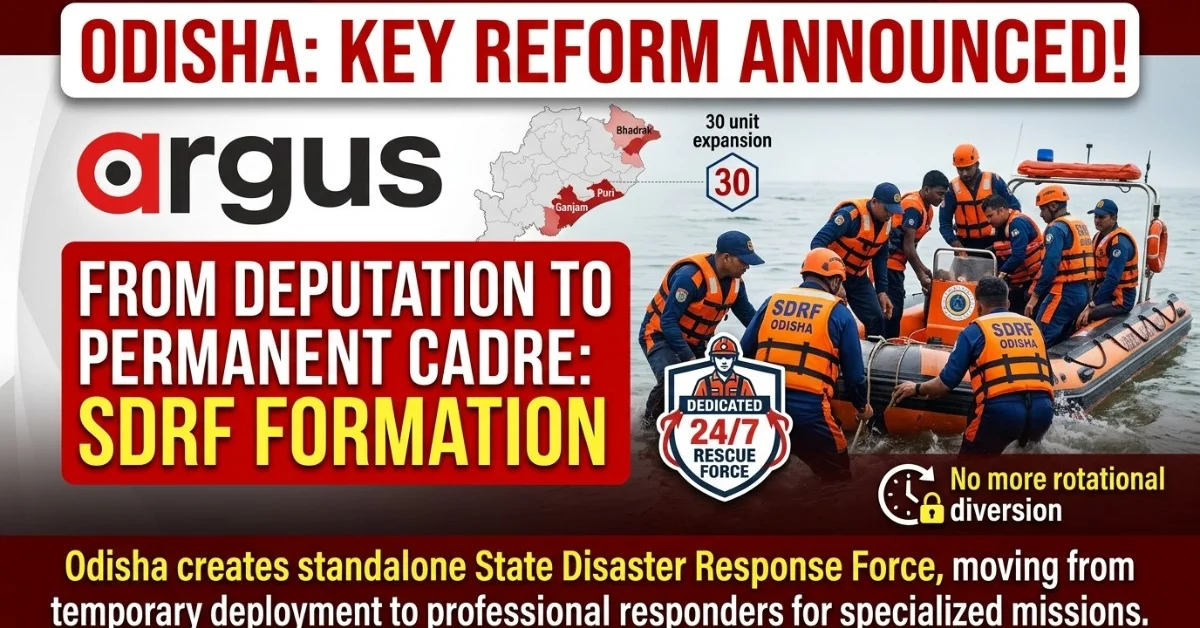
Odisha Strengthens Climate Resilience: State Establishes Dedicated Disaster Response Force
In a significant shift toward proactive disaster management, the state of Odisha has officially integrated its disaster response capabilities into the formal framework of a State Disaster Response Force (SDRF). While the state has long been recognized as a global leader in cyclone mitigation and community-based evacuation strategies, it had remained one of the few high-risk regions operating without a formally designated SDRF—a status that has now been rectified. By elevating its existing emergency response infrastructure to the national SDRF standard, Odisha becomes the seventh state in the country to adopt this structured approach to calamity management.
This transition marks a departure from the previous reliance on ad-hoc crisis management teams toward a permanent, specialized, and highly trained cadre. For a state that frequently sits in the crosshairs of Bay of Bengal cyclonic systems, this institutional upgrade is expected to streamline coordination between central agencies, such as the National Disaster Response Force (NDRF), and local administrative units. The move is not merely a bureaucratic rebranding; it represents a fundamental commitment to professionalizing the front-line defense against the increasing frequency of extreme weather events.
From ODRAF to SDRF: Upgrading the Tactical Framework
For years, the Odisha Disaster Rapid Action Force (ODRAF) served as the primary pillar of the state’s emergency response. While ODRAF earned a reputation for efficiency and bravery during major flood events and super-cyclones, the transition to an official SDRF status brings the force under a more standardized, nationalized regulatory framework. This change introduces rigorous cadre rules that define clear career progression, specialized training mandates, and equipment procurement protocols.
The new SDRF structure ensures that the force is no longer treated as a supplementary duty for general law enforcement personnel. Instead, it creates a dedicated career path for disaster management professionals. Under the new guidelines, personnel will undergo specialized training in high-risk search and rescue operations, structural collapse mitigation, swift-water rescue, and chemical, biological, radiological, and nuclear (CBRN) emergency response. By aligning with national SDRF standards, the Odisha force now benefits from synchronized protocols that allow for seamless integration with federal forces when a disaster exceeds the state’s immediate response capacity.
Strategic Recruitment and Deployment Plans
The establishment of the SDRF is accompanied by a robust recruitment and deployment strategy designed to ensure that specialized personnel are stationed strategically across the state’s most vulnerable geographic zones. The recruitment plan prioritizes individuals with backgrounds in emergency services, engineering, and medical support, ensuring a multi-disciplinary team capable of managing the complex aftermath of natural disasters.
The deployment model emphasizes a decentralized approach. By positioning specialized units in high-risk coastal and riverine districts, the state aims to reduce the "golden hour" response time—the critical window immediately following a disaster where life-saving intervention is most effective. Furthermore, the new cadre rules stipulate regular rotations and continuous skill-upgrading programs, ensuring that the force remains at the cutting edge of rescue technology and methodology. This institutional permanence is vital for maintaining morale and expertise within a field that is physically and mentally demanding.
What This Means for Farmers
For the agricultural community in Odisha, the institutionalization of the SDRF has direct and profound economic implications. Farmers are the most vulnerable demographic during extreme weather events, often suffering the total loss of standing crops, livestock, and essential infrastructure during floods and cyclones. The impacts of this development include:
- Faster Post-Disaster Assessment: With a more professionalized force, the speed at which damage assessment teams can reach remote rural areas will increase. This leads to faster processing of insurance claims and government compensation, which is critical for the next planting cycle.
- Improved Infrastructure Protection: Dedicated SDRF units are trained in specialized debris clearance and emergency drainage management, which can help mitigate the secondary damage caused to rural roads and irrigation canals immediately after a disaster.
- Enhanced Livestock Safety: The new force includes specialized training for animal rescue operations. For smallholder farmers, whose livestock often represents their primary capital, this is a significant layer of financial protection.
- Reduced Economic Downtime: By streamlining rescue and recovery, the SDRF helps rural communities return to normalcy more quickly. This reduces the prolonged period of economic stagnation that follows a major climate event, allowing farmers to focus on land preparation and crop recovery rather than emergency survival.
- Long-term Resilience: The presence of a permanent, well-equipped force provides a level of stability that encourages long-term agricultural investment, as farmers can have greater confidence in the state's ability to protect their livelihoods against the backdrop of climate volatility.