Parliamentary Protest Highlights Disparity in Sports Infrastructure Investment
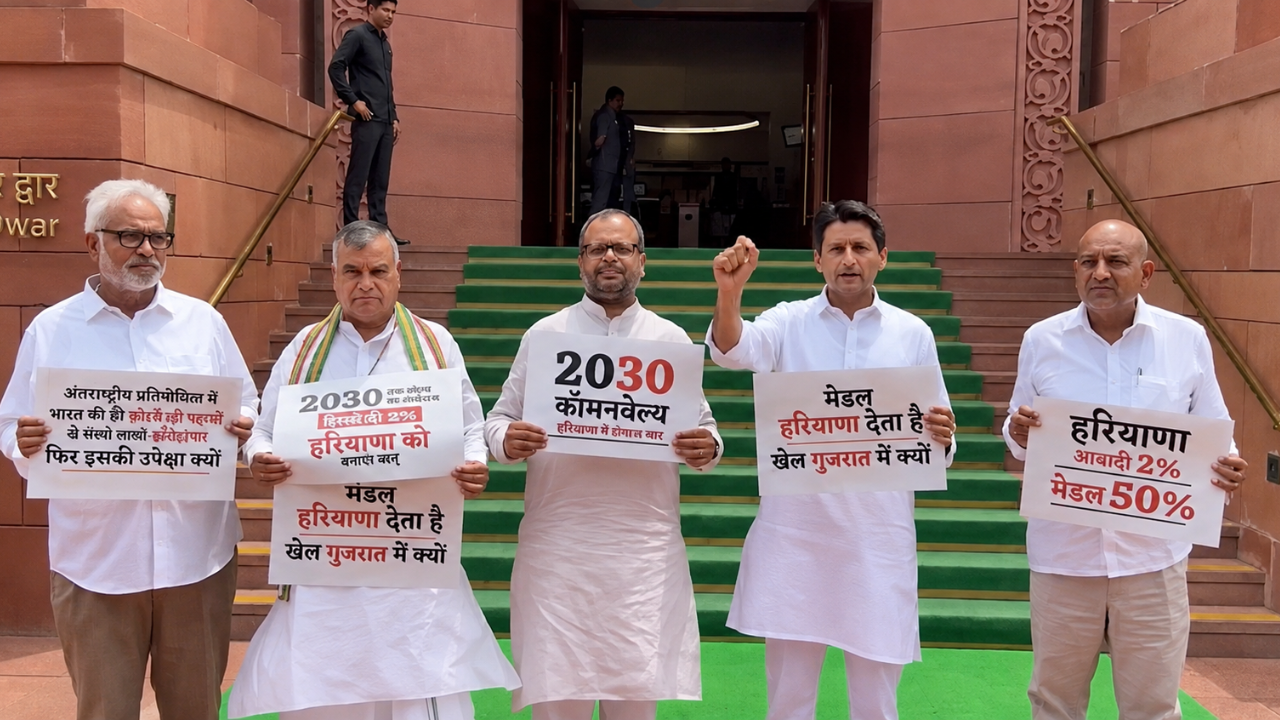
The corridors of power in New Delhi became the stage for a heated debate this week as Rohtak Member of Parliament, Deepender Singh Hooda, voiced strong opposition regarding the selection of host venues for upcoming international sporting events. During the parliamentary session, Hooda staged a formal protest, challenging the decision to designate Gujarat as the primary host for the 2030 Commonwealth Games. The core of his argument rests on a demand for geographic and economic equity, suggesting that the state which contributes the most to India’s international sporting success should be prioritized for infrastructure development and event hosting.
Hooda’s intervention has sparked a broader conversation regarding how India allocates resources for sports. By positioning Haryana—a state widely recognized as a powerhouse in wrestling, boxing, and athletics—against the current hosting plan, the protest underscores a growing tension between centralized infrastructure development and the grassroots realities of India’s competitive sporting landscape.
The Case for Haryana: A Proven Sporting Powerhouse
The primary pillar of Hooda’s argument is rooted in the empirical performance of Haryana’s athletes on the global stage. In his address to the house, he emphasized that athletes representing Haryana have consistently secured more than 50 percent of India’s total medal tally in major international competitions, including the Commonwealth Games, Asian Games, and Olympic events. This dominance is not accidental; it is the result of decades of investment in village-level sports nurseries, specialized coaching centers, and a deep-rooted cultural emphasis on physical conditioning and competitive sports.
From an agricultural and rural development perspective, Haryana’s success is intrinsically linked to its rural infrastructure. Many of India’s top-tier athletes hail from farming families, where the physical rigors of agricultural life are often channeled into professional training. Hooda argued that by hosting an event of the magnitude of the Commonwealth Games, the state could leverage that existing momentum to modernize its facilities further. The contention is that if the government is investing in a host city, that investment should logically be placed where the sporting ecosystem is already thriving and where the return on investment—in terms of athlete development and facility utilization—would be most immediate.
Infrastructure Decentralization and Regional Economic Growth
The debate extends beyond mere athletic pride; it touches upon the economic strategy of regional development. Critics of the current hosting plan argue that concentrating international sporting infrastructure in a single industrial hub—in this case, Gujarat—ignores the potential for regional revitalization in the northern belt. Hosting a Commonwealth-level event requires massive upgrades to transport links, hospitality services, and specialized training venues, all of which serve as catalysts for local economic growth.
For a state like Haryana, which remains the backbone of India’s food security through its robust agricultural output, hosting such an event would provide a platform to integrate sports tourism with the state’s existing rural economy. Hooda’s protest highlights a desire for a more balanced distribution of federal grants and project allocations. The argument is that while Gujarat possesses the industrial capacity to host, Haryana possesses the human capital and the proven track record that warrants a more significant share of the national spotlight.
What This Means for Farmers
While the protest was centered on sports, the implications for the agricultural community are significant. For farmers, the centralization of infrastructure projects often dictates where government spending is prioritized, affecting everything from road connectivity to power reliability and market access.
- Investment in Rural Assets: When a state is designated as a major event host, the surrounding infrastructure—such as highways, cold-storage chains, and digital connectivity—is often fast-tracked. Farmers in regions that successfully lobby for such projects stand to benefit from improved logistics for transporting perishable goods to urban markets.
- Diversification of Livelihoods: As Haryana continues to produce world-class athletes, the link between the farm and the arena is strengthening. Families often utilize income from agricultural land to support the high costs of specialized nutrition and equipment. A surge in local sports infrastructure can reduce the financial burden on farming households by providing high-quality, government-subsidized facilities near their homes.
- Policy Advocacy and Representation: This protest serves as a reminder of the importance of political representation for agricultural states. Farmers are encouraged to monitor how their elected representatives prioritize regional development projects, as these decisions directly influence the long-term economic trajectory of their rural communities.
- Leveraging Regional Success: The economic success of a state is often tied to its ability to brand itself. If Haryana is recognized as the "Sports Capital of India," it creates opportunities for agro-tourism and local business development that can supplement traditional income streams during lean agricultural seasons.