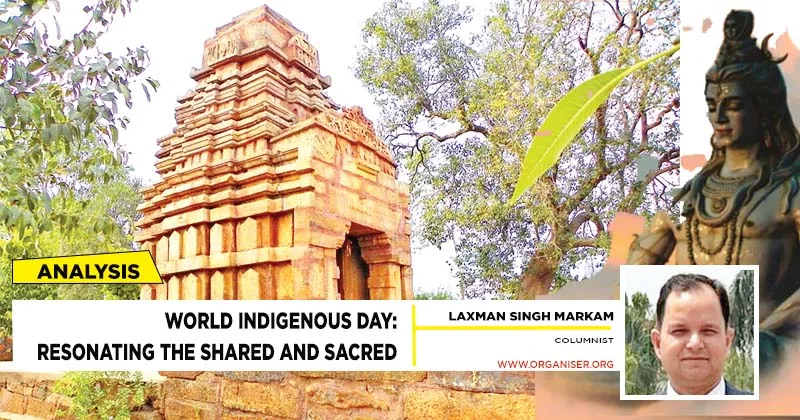
World Indigenous Day: Celebrating the Sacred Ecology of Bharat’s Janajatiya Communities
As the world marks Indigenous Day, it is a poignant moment to reflect on the deep, enduring relationship between Bharat’s Janajatiya (Scheduled Tribe) communities and the broader tapestry of Hindu tradition. This relationship is not merely a subject for academic debate but a living, breathing reality that continues to shape the cultural and spiritual landscape of the nation. For centuries, Janajatiya communities—spanning from the Himalayan ranges to the central plateaus and eastern river valleys—have served as the custodians of some of the oldest surviving cultural traditions in Bharat. Their religious systems, rooted deeply in the veneration of nature, ancestors, and localized deities, provide a profound insight into the early origins of Indic spiritual thought.
Nature as the Original Sacred Space
Long before the construction of elaborate temple complexes and the formalization of institutional religious structures, the spiritual geography of Bharat was defined by the landscape itself. For Janajatiya communities, the divine was not confined to stone idols within mandirs but was omnipresent in the physical world. Mountains, rivers, ancient trees, caves, and sacred groves functioned as the primary sites of worship, acting as conduits between the human and the cosmic.
This "nature-first" approach to spirituality finds a significant parallel in the Shaiva and Shakta traditions of the wider Hindu fold. Shiva, in his various manifestations—as Mahadev, Pashupati (Lord of Animals), Girisha (Lord of the Mountains), and Kirata (the Hunter)—is intrinsically linked to the wilderness. He is the deity of the ascetics, the forest dwellers, and those living beyond the boundaries of urban civilization. Similarly, the Shakti tradition celebrates the divine feminine through local goddesses who protect the village, govern fertility, and watch over the forests. This shared reverence for the earth is not a coincidence; it reflects a foundational Bharatiya ethos that recognizes the sacredness of the environment as a living, breathing entity.
Convergence of Symbolism and Archaeological History
The historical continuity of these traditions is supported by a fascinating blend of anthropology, folklore, and archaeology. The famous "Pashupati Seal" discovered in the Indus Valley Civilisation, depicting a figure surrounded by animals in a meditative posture, remains a cornerstone of this discussion. While scholars continue to debate the specific identity of the figure, the symbolism of a "Lord of Animals" presiding over the wild has persisted for millennia in the ritual lives of communities like the Gond, Bhil, Koya, and Maria. These groups have historically integrated the worship of Bada Deo (often identified with Mahadev) or local Mother Goddesses into their daily existence, maintaining a spiritual framework that is both diverse and deeply connected to the land.
This diversity is a testament to the richness of Bharat’s indigenous identity. With over seven hundred Scheduled Tribes, there is no monolithic "Janajatiya religion." Instead, there is a vibrant mosaic of beliefs—from Sarna and Donyi-Polo to Bathou and Seng Khasi—each offering a unique perspective on the divine. By studying these traditions alongside classical Sanskrit literature, we gain a more holistic understanding of the religious history of Bharat, moving beyond textual analysis to appreciate the lived experiences of those who have guarded the forests and hills for generations.
What This Means for Farmers
For the modern farming community, the traditional knowledge embedded within Janajatiya practices offers more than just historical interest; it provides a blueprint for ecological resilience. The Janajatiya ethic of living in harmony with nature is an ancient form of sustainable agriculture that is increasingly relevant in the face of modern climate volatility.
- Conservation through Custom: The practice of maintaining sacred groves—where the cutting of trees and hunting of animals is traditionally prohibited—serves as a natural model for biodiversity conservation. Farmers can draw inspiration from these localized "no-go" zones to protect local water sources and soil health on their own lands.
- Agricultural Cycles as Ritual: Indigenous traditions mark agricultural cycles with festivals of gratitude to the earth. Adopting this mindset of "reciprocity" with the land, rather than viewing it merely as a factory for production, can encourage farmers to adopt more regenerative soil management practices that prioritize long-term fertility over short-term yields.
- Ecological Balance: The veneration of Pashupati and other forest deities emphasizes the vital role of animals in the agricultural ecosystem. Recognizing the interdependence between livestock, wildlife, and the farm landscape can lead to more holistic farm management, where the preservation of local flora and fauna is seen as an asset to production rather than an impediment.
- Valuing Traditional Wisdom: Farmers are encouraged to look toward regional indigenous knowledge regarding local crop varieties and water harvesting techniques. These methods, refined over centuries of direct engagement with the local terrain, often prove to be more resilient to regional weather patterns than generic, imported agricultural models.
By honoring the sacred landscapes that our ancestors revered, the modern agricultural sector can find a path toward a more sustainable and spiritually grounded future, ensuring that the land remains productive and protected for generations to come.