From Legacy to Logic: Gujarat’s Student Innovators Redefine the Technological Frontier
The spirit of late IT visionary Dewang Mehta continues to permeate the academic halls of Gujarat, acting as a catalyst for a new generation of technological pioneers. The 14th edition of the Dewang Mehta Awards has concluded, serving as a powerful testament to the state’s burgeoning reputation as an incubator for high-level engineering talent. With 245 distinct projects submitted from 58 colleges across 20 cities, the competition highlighted a seismic shift in how students are approaching real-world problem-solving, moving beyond theoretical frameworks to deploy functional, AI-driven solutions.
The event, which saw the "Maverick Effect AI Challenge" draw an impressive 619 participants, underscored a growing trend in higher education: the integration of artificial intelligence with localized, grassroots challenges. While the global tech discourse often focuses on abstract generative AI, the projects showcased in Gujarat were grounded in tangible utility. From autonomous navigation to environmental stewardship and precision agriculture, the diversity of the entries suggests that Gujarat’s engineering students are not merely following industry trends, but are actively shaping the future of industrial and rural technology.
Engineering Solutions for a Complex World
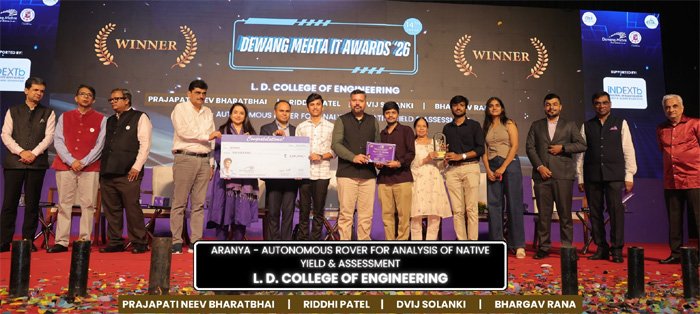
The winning projects at this year’s awards demonstrated a sophisticated understanding of both hardware integration and algorithmic efficiency. Among the standout entries was the "ARANYA" rover, a robotic system designed for autonomous navigation in challenging terrains. By utilizing advanced machine learning models for path planning and obstacle avoidance, the ARANYA project represents a significant leap forward in mobile robotics, with potential applications ranging from automated search and rescue operations to remote environmental monitoring in rugged landscapes.
Complementing these mechanical advancements were software-heavy solutions aimed at sustainability. The AI-powered waste segregation systems presented at the event offered a glimpse into the future of urban waste management, utilizing computer vision to identify and sort recyclable materials with high precision. By automating the sorting process, these systems address one of the most persistent bottlenecks in circular economy initiatives. These innovations are not isolated experiments; they represent a concerted effort by students to bridge the gap between complex AI capabilities and the practical, often messy, realities of infrastructure and resource management.
Perhaps most notable for the regional economy was the focus on agricultural robotics. As the sector faces increasing pressure to optimize yields while managing labor shortages and climate variability, the student-led initiatives in agri-tech provided a roadmap for modernizing traditional farming practices. By applying AI to crop health monitoring and precision inputs, these young innovators are positioning themselves to play a critical role in the state’s agricultural future.
What This Means for Farmers
For the agricultural community, the success of these student innovators signals a shift toward a more data-driven and automated future. While many of these projects remain in the prototype or pilot phase, their core principles offer immediate takeaways for the modern grower:
- Increased Precision: AI-powered solutions, such as those demonstrated in the agricultural robotics category, are moving toward "individual plant care." This allows for the targeted application of water, fertilizers, and pesticides, which can significantly reduce input costs and mitigate environmental runoff.
- Labor Efficiency: The emergence of autonomous systems like the ARANYA rover indicates that the industry is preparing for a future where routine, labor-intensive tasks—such as field inspection and basic logistical support—can be offloaded to robotic assistants, allowing farmers to focus on high-level management decisions.
- Waste and Resource Optimization: Technologies that improve waste segregation and resource management at the municipal level will eventually trickle down to farm-gate operations. Improved supply chain efficiency, powered by smart algorithms, will likely lead to better post-harvest handling and reduced losses for producers.
- Strategic Investment: As these technologies transition from university laboratories to commercial availability, farmers should prioritize investments in modular, scalable tech. The focus should not be on "all-or-nothing" automation, but on adopting small-scale AI tools that address specific, recurring pain points in the seasonal cycle.
The Dewang Mehta Awards have proven that Gujarat’s classrooms are no longer just places of learning; they are active launchpads for the technologies that will define the next decade of industry and agriculture. For the farming sector, this influx of innovation promises a future where technology is not an intimidating hurdle, but a practical tool for building resilience and profitability.