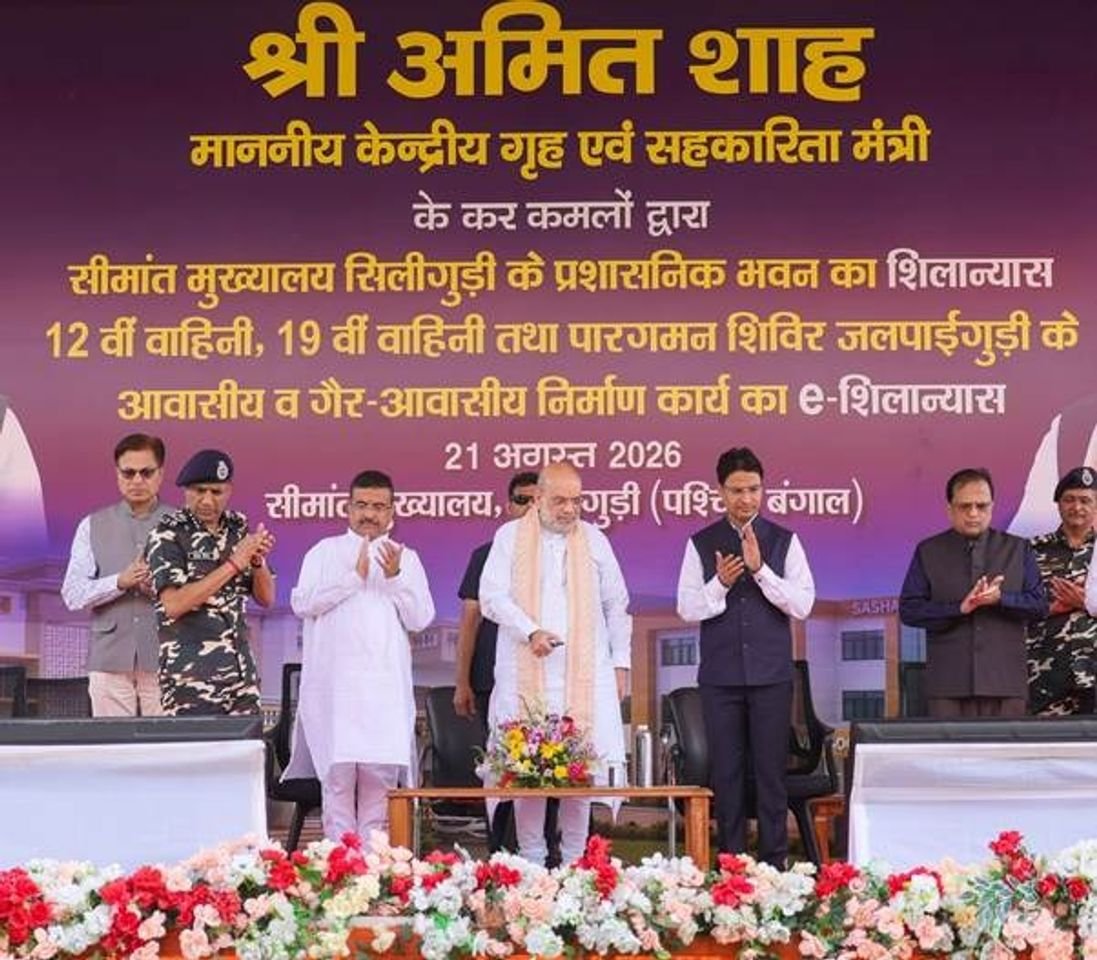
Union Home Minister and Minister of Cooperation Amit Shah visited Siliguri, West Bengal, on August 21 to inaugurate and lay the foundation stones for several infrastructure projects intended to support the Sashastra Seema Bal (SSB). During the event, which was attended by West Bengal Chief Minister Suvendu Adhikari and other senior officials, the Home Minister addressed a range of national security issues, the significance of the national song ‘Vande Mataram,’ and the federal government's developmental goals for the nation.
Infrastructure and Security Initiatives for the SSB
The Home Minister announced new projects valued at ₹189 crore aimed at enhancing the administrative and residential facilities for SSB personnel. These developments are part of a broader effort to prioritize the requirements of security forces, including the Border Security Force (BSF) and the Assam Rifles, which Shah noted have been at the top of the Ministry of Home Affairs' agenda during his tenure.
The foundation stones laid during the visit include:
- An administrative building for the SSB’s Frontier Headquarters in Siliguri, spanning 80 acres.
- Infrastructure for the 19th Battalion in Thakurganj.
- An e-foundation stone for the 12th Battalion in Kishanganj.
- A new Transit Camp at New Jalpaiguri.
Shah emphasized that the SSB faces unique challenges, as it is tasked with monitoring open borders. Since the adoption of the 'One Border, One Force' policy following the Kargil War, the SSB has been responsible for guarding the 1,751-kilometre India-Nepal border and the nearly 700-kilometre India-Bhutan border.
Strategic Focus on the Siliguri Corridor
A significant portion of the Home Minister's address focused on the Siliguri Corridor, a strategically sensitive region that connects eight states and shares international borders with Nepal, Bhutan, and Bangladesh. Shah stated that the central government has worked to secure this corridor through a "triangular grid," increasing the presence and dominance of security forces in the area.
The Minister highlighted the role of state-center cooperation in these security efforts. He noted that while the Government of India had been seeking land for security agencies since 2014, previous administrations in West Bengal had not provided it. He commended Chief Minister Suvendu Adhikari for granting in-principle approval for the allocation of 560 acres of land, which the government deems necessary to fully secure the corridor.
Furthermore, Shah mentioned that 1,139 acres of land were provided for the BSF and SSB within 45 days of the current West Bengal government taking office. The Minister also outlined plans to improve connectivity in the region, noting that the Delhi-Siliguri corridor is included in the seven high-speed rail corridors approved in the 2026-27 Budget, and that stations in Siliguri and Jalpaiguri have been transformed under the Amrit Bharat Scheme.
Perspectives on ‘Vande Mataram’ and Cultural Nationalism
During his speech, Amit Shah reflected on the 80th anniversary of India’s independence, observed on August 15. He highlighted that for the first time, the complete rendition of the national song ‘Vande Mataram’ was performed from the ramparts of the Red Fort, marking 150 years since the composition was written by Bankim Chandra Chattopadhyay.
Shah asserted that the composition played a vital role in the freedom movement and provided a vision for independent India based on "cultural nationalism." He alleged that the song was never wholeheartedly embraced by the main opposition party, even after the partition of the country at the time of Independence. He expressed concern that, while the song is sung in Parliament, the complete version is often not performed.
The Home Minister stated that the Ministry of Home Affairs has recently passed a Bill in Parliament to mandate the complete rendition of ‘Vande Mataram’ in government programs. He suggested that integrating the full song into daily school activities would help instill a sense of patriotism in the youth.
The ‘Saptadhara’ and Future Developmental Goals
Shah detailed the ‘Saptadhara’—the seven streams of strength announced by Prime Minister Narendra Modi—which the government intends to use to empower the nation. These seven key areas include:
- Manufacturing power
- Defence strength
- Agriculture and food processing
- Green and blue economy
- Technology and innovation
- Gati Shakti (Infrastructure)
- India’s soft power
In addition to these pillars, the Minister mentioned specific targets, including achieving 100 GW of nuclear power capacity by 2047 and the launch of eight new semiconductor plants over the next three years. He also referenced the Vibrant Villages Programme, which involves an expenditure of ₹6,839 crore to improve infrastructure and establish emotional connections with communities residing along the Bangladesh and Bhutan borders.
Tributes and Official Presence
The event concluded with the Home Minister paying tribute to two prominent figures on their death anniversaries:
- Ustad Bismillah Khan, the renowned Shehnai maestro, whom Shah credited with popularizing Indian classical music on the global stage.
- Kalyan Singh, the former Chief Minister of Uttar Pradesh, whom Shah recognized for his administrative contributions and his role in the Ram Janmabhoomi movement.
The event was attended by various dignitaries, including Union Home Secretary Govind Mohan, Intelligence Bureau Director Mahesh Dixit, Secretary of Border Management Dr. Rajendra Kumar, SSB Director General Sanjay Singhal, and Darjeeling Lok Sabha MP Raju Bista.