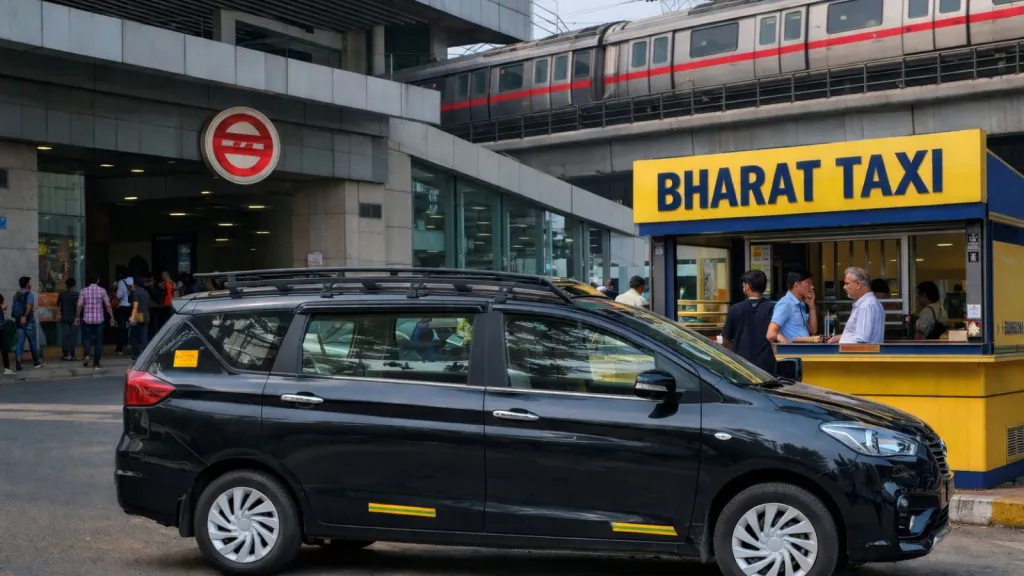
India’s ride-hailing sector is undergoing a structural shift with the introduction of Bharat Taxi, a platform that describes itself as the country’s first cooperative-led ride-hailing service. Launched on June 6, 2025, the platform operates on the principle of “Saarthi Hi Maalik”—meaning the driver is the owner. By integrating digital technology with a cooperative framework, the initiative seeks to move away from the traditional, transactional relationship between drivers and technology companies, instead positioning drivers as stakeholders in the business.
The Cooperative Foundation
According to the source material, Bharat Taxi was established under the Multi-State Cooperative Societies Act, 2002. This legal framework allows the platform to function across multiple states while adhering to cooperative principles such as democratic participation, voluntary membership, and mutual assistance. The platform is backed by eight prominent national-level cooperative institutions, which provide the institutional support necessary for its operations:
- National Cooperative Development Corporation (NCDC)
- Indian Farmers Fertiliser Cooperative Limited (IFFCO)
- National Bank for Agriculture and Rural Development (NABARD)
- Krishak Bharati Cooperative Limited (KRIBHCO)
- Gujarat Cooperative Milk Marketing Federation Limited (Amul)
- National Agricultural Cooperative Marketing Federation of India Limited (NAFED)
- National Dairy Development Board (NDDB)
- National Cooperative Export Limited (NCEL)
Unlike conventional ride-hailing companies where the company owns the digital infrastructure and drivers operate as independent contractors, Bharat Taxi links ownership directly to the people performing the work. This model is intended to ensure that those whose labor sustains the platform also have a voice in its governance and a share in its economic outcomes.
“Saarthi Hi Maalik”: The Member-Owner Model
The core of the Bharat Taxi model is the role of the Sarathi (the driver). Rather than being treated merely as a service provider, a Sarathi is considered a member-owner of the cooperative. This status provides several distinct features:
- Share Capital Participation: Sarathis can acquire ownership rights by subscribing to the cooperative’s share capital. While individual shares are valued at Rs 100, a driver can become a partner by purchasing shares worth Rs 500.
- Governance Rights: The cooperative structure allows for Sarathi members to have representation on the Board of Directors. This gives drivers a formal mechanism to influence the platform’s decision-making and operational development.
- Economic Alignment: The platform aims to bridge the gap between ownership, participation, and earnings, ensuring that the growth of the cooperative directly benefits the drivers.
A Zero-Commission Economic Structure
Bharat Taxi differentiates itself from conventional digital mobility platforms through a zero-commission and surge-free pricing model. The goal is to provide financial stability for drivers while maintaining price predictability for passengers.
Under this system, the platform utilizes a subscription-based approach. Sarathis retain their full fare earnings from individual trips. The cooperative earnings are distributed as follows:
- 80% of earnings are distributed directly among Sarathis, calculated based on the distance covered by their vehicles.
- 20% of earnings are credited to the platform as the Sarathis’ collective capital.
- A 7% service charge is applied exclusively at airport prepaid booths managed by Bharat Taxi to cover operational expenses.
By removing surge pricing and convenience fees, the platform aims to provide clarity to passengers, while the lack of traditional commission structures is designed to increase the take-home pay for drivers.
Platform Services and Operational Reach
Bharat Taxi is designed to function as a comprehensive transport solution rather than a single-category app. Passengers can access a variety of services, including 2-wheeler or bike taxis, auto-rickshaws, economy cabs, premium sedans, and XL/SUV vehicles. The app also supports specialized travel needs such as rentals, out-station travel, and scheduled rides.
To ensure accessibility, the platform combines its digital application with physical infrastructure, such as prepaid booths at selected airports. This hybrid approach is intended to cater to different types of passengers and travel situations.
Growth and Future Expansion
Since its establishment in mid-2025, Bharat Taxi has scaled rapidly. As of July 25, 2026, the platform reported nearly 8 lakh registered Sarathis and approximately 41 lakh registered customers. The platform is currently active in:
- Delhi-NCR
- Gujarat
- Lucknow
- Chandigarh
- Mumbai
- Jaipur
- Kanpur
- Pune
The platform’s expansion in Jaipur serves as a notable example of its traction, with over 30,000 Sarathis and nearly 7 lakh customers joining in that city alone by late July 2026. Looking ahead, the organization plans to introduce its services in Ranchi, Patna, Guwahati, Bhopal, Kolkata, Indore, and Nagpur in the coming months. The long-term objective is to achieve a nationwide presence by 2029.
The success of this expansion will be a critical test for the cooperative model, as it seeks to demonstrate that a member-owned digital platform can effectively manage diverse transport patterns, varying customer preferences, and the complex regulatory environments found across different Indian cities.