National Space Day: Celebrating India's Journey to Global Space Leadership
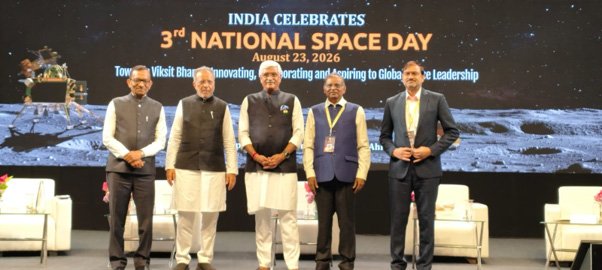
The recent celebration of National Space Day in Ahmedabad has brought renewed focus to India’s rapid advancement as a global space power. The event highlighted how the vision of Vikram Sarabhai, often regarded as the father of the Indian space programme, has evolved from early foundational efforts into a modern industry that impacts the daily lives of millions of citizens.
According to the Navjeevan Express, the significance of this milestone lies not just in scientific achievement, but in the practical integration of space technology into essential sectors. As India continues its march toward global leadership in this domain, the transition from laboratory research to real-world application has become a defining characteristic of the nation’s space trajectory.
Space Technology in Daily Life
The impact of India’s space programme is increasingly visible across various facets of society. The report emphasizes that space technology is no longer confined to academic or research environments. Instead, it is actively utilized to provide tangible benefits in several critical areas:
- Agriculture: Leveraging satellite data to assist in farming practices.
- Healthcare: Enabling remote diagnostics and connectivity for medical services.
- Connectivity: Improving communication infrastructure across the country.
- Disaster Management: Using space-based imagery and data for better preparedness and response to natural calamities.
The Next Phase: Emerging Technologies
Looking toward the future, the space economy in India is poised for a significant transformation. The Navjeevan Express indicates that the next phase of development will be driven by the integration of advanced technologies. These innovations are expected to redefine the capabilities and efficiency of India’s space missions and industrial output.
Key technological pillars identified for this next phase include:
- Artificial Intelligence (AI): Enhancing data processing and autonomous decision-making in space operations.
- Quantum Computing: Providing superior computational power for complex orbital mechanics and secure communications.
- Robotics: Increasing the capability for remote exploration and maintenance of space assets.
- Semiconductors: Strengthening the hardware backbone required for sophisticated satellite and launch vehicle electronics.
The Role of Gujarat and the Private Sector
A notable aspect of the current space landscape is the shifting ecosystem involving new stakeholders. The state of Gujarat is positioning itself to play a pivotal role in this growth. This development is supported by an increasing synergy between the traditional space sector and the expanding ecosystem of private industry and start-ups.
This shift suggests a move toward a more collaborative model, where the expertise of established institutions is complemented by the agility and innovation of private enterprises. By fostering this environment, the nation aims to maintain its momentum in an increasingly competitive global space economy.
As India reflects on its progress from the foundational dreams of its pioneers to the current era of high-tech space exploration, the emphasis remains on ensuring that these advancements translate into meaningful progress for the country at large. The National Space Day event in Ahmedabad serves as a reminder that for India’s space aspirations, the sky is truly no longer the limit.