The Global Resurgence of Ayurveda: A New Pillar of India’s Health Diplomacy
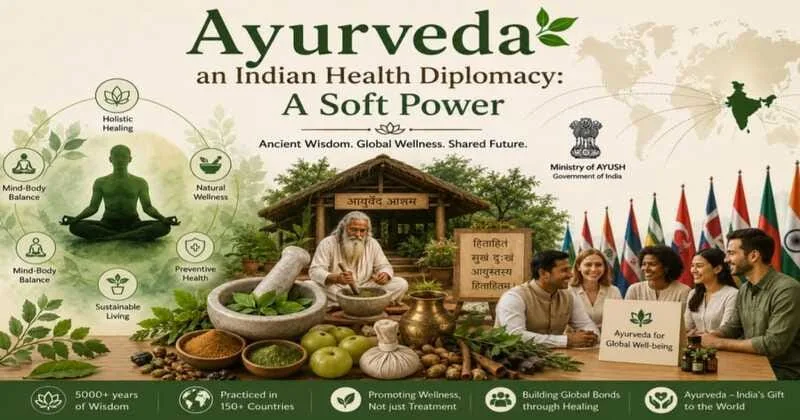
The ancient Vedic aspiration, “Sarve bhavantu sukhinah, sarve santu niramayah”—may all be happy, may all be free of disease—has transcended the boundaries of traditional gurukuls to become a foundational principle in modern global health governance. With the establishment of the World Health Organisation’s (WHO) first Global Traditional Medicine Centre (GTMC) in Jamnagar, Gujarat, in 2022, the international community has formally acknowledged that the future of holistic health is being charted on Indian soil. This institutional milestone is not merely a symbolic gesture; it represents the culmination of a decade-long strategic effort to integrate Ayurveda into the global medical lexicon, effectively transforming India’s civilisational heritage into a potent instrument of soft power.
According to the NITI Aayog’s latest report, Strategic Roadmap for Making Ayurveda Global (2026), the Jamnagar centre serves as the nerve center for policy development, data analytics, and cross-border innovation. By positioning Ayurveda at the core of international public health, India is moving beyond cultural advocacy and toward a systematic, evidence-based integration of traditional wisdom into the global health architecture.
From Institutional Elevation to Global Integration
The trajectory of Ayurveda’s global influence reflects India’s broader governance evolution. For decades following Independence, traditional medicine was managed as a peripheral function within the Ministry of Health and Family Welfare. The decisive pivot occurred in 2014 with the creation of the Ministry of Ayush, a move that signaled a top-tier commitment to mainstreaming traditional systems. This institutional elevation has yielded tangible results, marked by approximately 75 Memoranda of Understanding (MoUs) with foreign governments and institutions, and the establishment of dedicated Ayush Academic Chairs in universities across continents.
The strategic framework for this expansion relies heavily on the "WHO Corridor." The inclusion of Ayurveda in the ICD-11 (International Classification of Diseases) Module 2 has been a watershed moment. By codifying Ayurvedic morbidity classifications into the official global disease lexicon, India has cleared the essential hurdle for integration into national health data systems and, eventually, international insurance reimbursement frameworks. The roadmap now advocates for a deeper regional presence, suggesting that India deploy regional Ayurveda advisors to all six WHO regional offices. These advisors would be tasked with aligning Ayurvedic interventions with regional priorities—ranging from non-communicable diseases to mental health—thereby ensuring that Ayurveda is viewed as a functional component of global public health rather than a niche cultural exhibit.
Academic Diplomacy and the Digital-First Strategy
A sophisticated soft power strategy requires a sustainable academic base. India’s current approach focuses on creating an "Ayurveda ecosystem" abroad that begins in the classroom. Through the Ayush Scholarship Scheme, hundreds of international students are trained in India, eventually returning to their home countries as ambassadors for the discipline. This is bolstered by a rigorous domestic infrastructure, including over 415 Ayush colleges and institutions of national importance, such as the Institute of Teaching and Research in Ayurveda (ITRA) and the All-India Institute of Ayurveda (AIIA).
To ensure this knowledge remains credible and accessible, the Ministry of Ayush has embraced digital transformation. The Ayush Research Portal now houses a repository of over 42,000 peer-reviewed publications, providing the scientific backbone necessary to satisfy international regulators. Furthermore, the roadmap proposes the "conscription" of India’s diplomatic missions as the frontline for Ayurveda. By equipping embassies with localized, digital-first information suites and crisis-response communication protocols, the Indian government aims to proactively address skepticism and provide transparent, data-backed answers to the international public. This represents a shift toward a "soft power with standard operating procedures" model, where diplomatic missions act as nodes for educational outreach and myth-busting.
What This Means for Farmers
While the global diplomacy of Ayurveda may seem distant from the fields of rural India, the economic implications for the agricultural sector are profound and direct. As Ayurveda is elevated to a global standard, the demand for high-quality, authentic, and traceable medicinal plants and herbs is projected to rise exponentially.
- Increased Demand for Medicinal Crops: As global markets integrate Ayurvedic products, farmers can expect a surge in demand for standardized raw materials. This shift encourages a transition from traditional subsistence crops to high-value medicinal and aromatic plants (MAPs), provided they meet global quality certifications.
- Need for Standardization: The global push for data and clinical evidence necessitates that the supply chain—from seed to shelf—adheres to strict quality control. Farmers who adopt Good Agricultural and Collection Practices (GACP) will find themselves at a competitive advantage in a market that increasingly prioritizes safety and efficacy data.
- Economic Upskilling: The expansion of the Ayush sector creates a "farm-to-pharmacy" bridge. Farmers who participate in contract farming models with certified Ayush manufacturers stand to benefit from more stable pricing and long-term supply agreements.
- Value Addition Opportunities: The roadmap’s emphasis on research and institutional growth suggests that the government will continue to incentivize domestic processing. For the rural economy, this means increased potential for small-scale primary processing units—such as drying, grading, and extraction facilities—that add value at the point of origin, keeping more profit within the farming community.
In essence, the globalization of Ayurveda serves as a catalyst for a more robust and modernized medicinal plant economy. For the Indian farmer, this institutional shift is not just a matter of national pride; it is a signal to modernize cultivation techniques and embrace the standards of a globalized, health-conscious market.