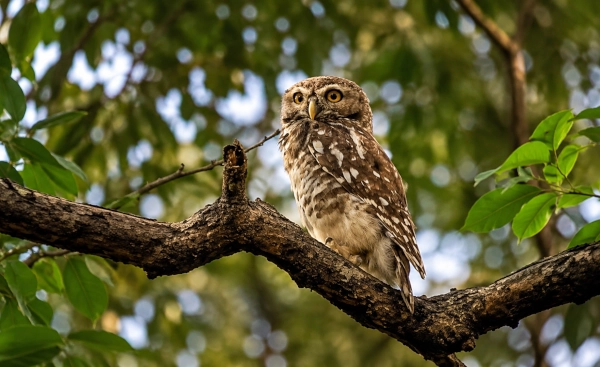
The Forest Owlet: A Remarkable Recovery in Central India’s Dry Deciduous Forests
In the annals of ornithological history, few stories are as compelling as the rediscovery of the Forest Owlet (Athene blewitti). Once considered a ghost of the past, this small, stocky raptor was feared extinct for over a century, having vanished from scientific records in 1884. For 113 years, the species remained a mystery, known only through museum specimens, until a dramatic rediscovery in the forests of northern Maharashtra in 1997 fundamentally shifted our understanding of biodiversity in Central India.
The Forest Owlet is distinct not only for its rarity but for its behavioral quirks. Unlike many of its nocturnal cousins, it is frequently active during daylight hours, a trait that makes it vulnerable to predation but also serves as a critical identification feature for field researchers. Since its re-emergence, intensive survey efforts have confirmed that the species persists in pockets of Maharashtra, Madhya Pradesh, and Gujarat. However, these populations remain highly fragmented, existing within a landscape that is increasingly pressured by land-use changes and human encroachment.
The Ecological Fragility of Central Indian Habitats
The survival of the Forest Owlet is inextricably linked to the health of the dry deciduous forests of Central India. These ecosystems, often overlooked in favor of the more charismatic rainforests or high-altitude ranges, serve as vital refuges for a specialized suite of flora and fauna. The owlet specifically favors teak-dominated forests and open woodland patches, which provide the essential hollow trees required for nesting.
The fragmentation of these habitats poses a significant barrier to the species' recovery. Because the Forest Owlet is a sedentary bird with limited dispersal capabilities, it cannot easily bridge the gaps between isolated forest patches. As development projects, agricultural expansion, and logging activities continue to carve up these corridors, the owlets find themselves confined to "islands" of habitat. This isolation limits genetic exchange between populations, potentially weakening the species' long-term resilience against environmental stressors and climate variability.
Conservation Challenges and the Path Forward
Conserving a species that was effectively "lost" for over a century presents unique challenges. The primary obstacle is the lack of comprehensive longitudinal data regarding its population density and exact range. While surveys have established the presence of the owlet in specific forest divisions, understanding the precise impact of habitat degradation on their breeding success remains an ongoing endeavor for wildlife biologists.
Efforts to protect the Forest Owlet have increasingly focused on community-based conservation and the integration of wildlife management into forest administration. Protecting the nesting trees themselves is a top priority, as is the maintenance of forest structure that supports the owlet’s prey base—which consists primarily of insects and small vertebrates. By preserving the structural complexity of these dry forests, conservationists aim to create buffer zones that allow for the natural expansion of existing owlet populations.
What This Means for Farmers
The presence of the Forest Owlet in the agricultural-forest interface offers significant, albeit often overlooked, benefits to the farming community. As a predator of insects and small rodents, the Forest Owlet serves as a natural biological control agent. In regions where these birds are active, they contribute to the management of pest populations that might otherwise damage crop yields. For farmers operating adjacent to forest boundaries, the owlet is a silent partner in integrated pest management (IPM).
Actionable Advice for Landowners:
- Retain Old-Growth Trees: If your land borders forest reserves, avoid clearing large, hollowed-out trees, as these are critical nesting sites for the Forest Owlet and other beneficial avian species.
- Minimize Chemical Pesticide Use: Because these owls consume insects, the use of broad-spectrum insecticides can lead to secondary poisoning. Adopting more selective or organic pest control methods helps maintain the health of the local raptor population.
- Support Buffer Vegetation: Maintaining hedgerows and patches of native, non-crop vegetation around farmland provides essential corridors for local wildlife, which in turn supports biodiversity that keeps agricultural ecosystems in balance.
- Community Engagement: Local farmers serve as the best stewards of the land. Reporting sightings of unusual, diurnal owls to local forest departments or biodiversity boards can provide researchers with invaluable data, helping to map the recovery of this rare species more accurately.
By viewing the Forest Owlet not as a hindrance to land use but as an indicator of a healthy, functioning ecosystem, farmers can play a pivotal role in ensuring that this species—which defied the odds to return after 113 years—does not disappear again.