Conflicting GST Rulings on Isabgol Seeds Bring Trade to Standstill
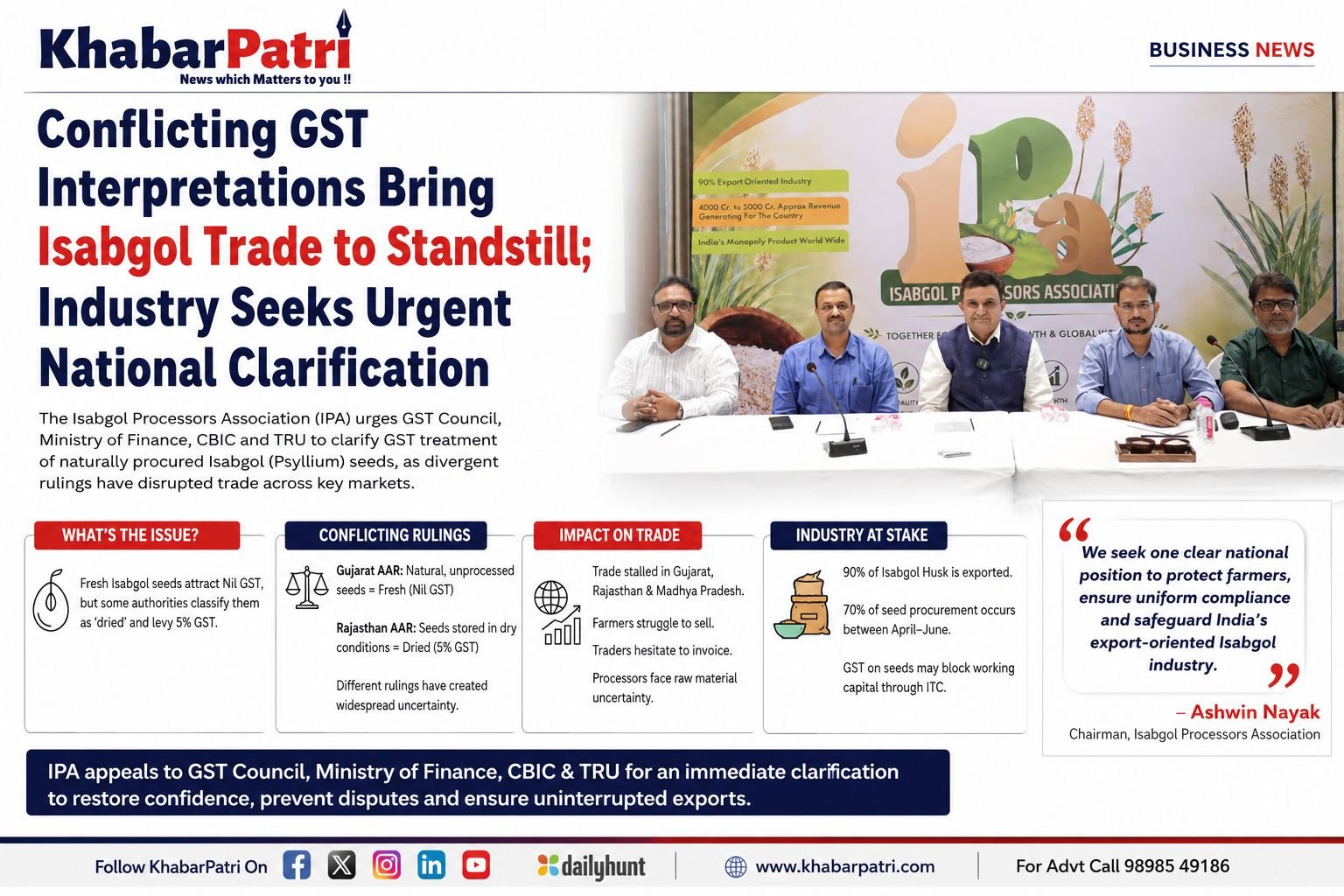
The Isabgol Processors Association (IPA) has formally requested urgent intervention from central authorities to resolve a growing crisis in the trade of naturally procured Isabgol (Psyllium) seeds. The association has reached out to the GST Council, the Ministry of Finance, the Central Board of Indirect Taxes and Customs (CBIC), and the Tax Research Unit (TRU), calling for an immediate nationwide clarification regarding the tax treatment of the commodity.
This request follows a period of significant uncertainty caused by contradictory Goods and Services Tax (GST) rulings issued by tax authorities in the states of Gujarat and Rajasthan. According to the IPA, these conflicting interpretations have effectively brought trade operations to a standstill, creating an environment of confusion for businesses involved in the processing and distribution of Isabgol.
The Need for Uniform Tax Policy
The core of the issue lies in the lack of a standardized approach to how Isabgol seeds are categorized and taxed under the GST framework. When different state authorities apply varying interpretations to the same product, it creates operational hurdles for businesses that often operate across state lines.
The Isabgol Processors Association has emphasized that without a clear, unified directive from the central government, stakeholders are unable to conduct their trade with certainty. The association's appeal for a "nationwide clarification" highlights the necessity for a single, authoritative stance that would apply consistently across all states, thereby ending the current ambiguity that has disrupted the industry.
Impact of Regulatory Ambiguity
According to the report by Khabarpatri English, the ongoing discrepancy between the rulings in Gujarat and Rajasthan has had a direct impact on the market. For businesses, the inability to determine the correct tax liability for Isabgol seeds creates substantial financial and operational risks.
Key concerns raised by the industry include:
- Operational Stagnation: Trade has come to a halt as processors and traders await clarity on tax compliance.
- Regulatory Conflict: Divergent rulings between major producing or processing states have created a fragmented regulatory landscape.
- Urgent Need for Resolution: The association has identified the GST Council and the Ministry of Finance as the primary bodies capable of resolving this deadlock through a definitive policy statement.
The Role of Central Authorities
The IPA is looking to several high-level government entities to provide a resolution. By engaging the CBIC and the Tax Research Unit (TRU), the association is seeking a technical and administrative fix to a problem that has transcended local jurisdiction.
The GST Council, which serves as the governing body for tax policy in India, is seen as the ultimate authority to settle such disputes. By providing a clear classification or a specific notification regarding the tax status of Isabgol seeds, these central bodies could provide the regulatory certainty required to resume normal trade activities.
As the situation develops, the industry remains in a state of flux, awaiting guidance that will dictate the future of Isabgol processing and trade compliance. The association’s proactive approach in seeking this clarification underscores the severity of the impact that inconsistent tax rulings can have on specific commodity markets.