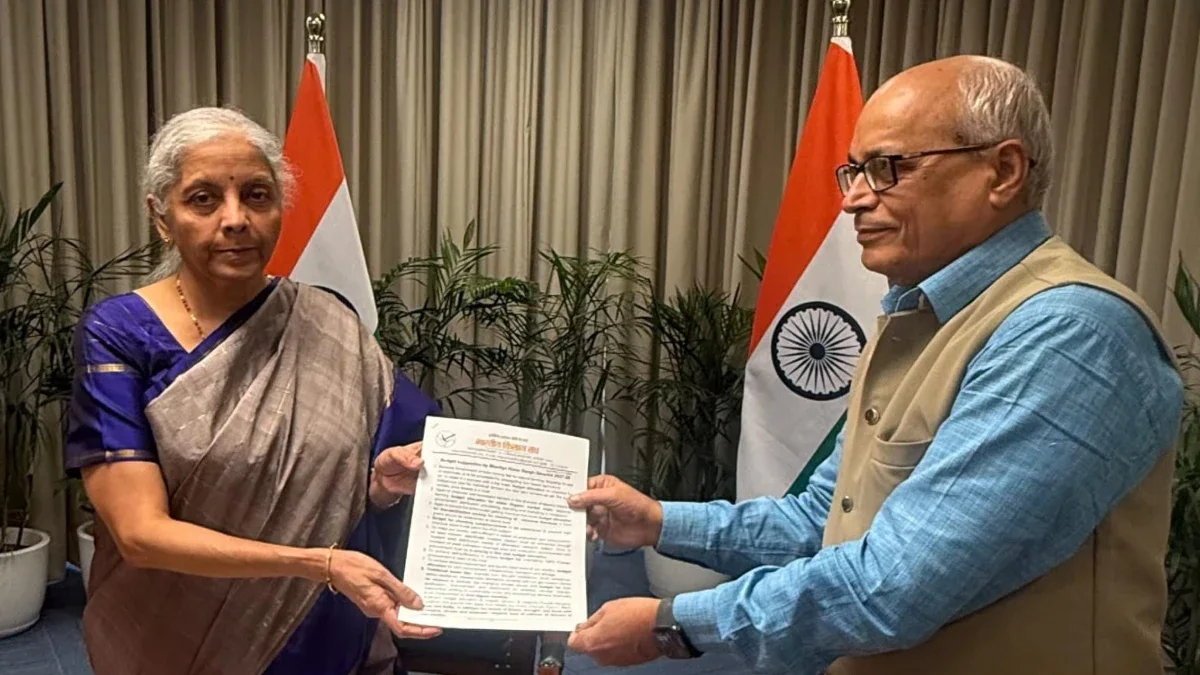
The Bharatiya Kisan Sangh (BKS) has formally presented a 17-point charter of suggestions and demands to Union Finance Minister Nirmala Sitharaman during a pre-Budget consultation meeting for the financial year 2027. The meeting, held at Kartavya Bhawan, saw BKS All India General Secretary Mohini Mohan Mishra outline key priorities aimed at strengthening the agricultural economy and enhancing farmer welfare.
Bharatiya Kisan Sangh Budget 2027 demands: Key Proposals for Natural and Sustainable Farming
A central theme of the BKS charter is the promotion of natural farming. The organisation has called for specific budgetary support to incentivize small and marginal farmers to rear indigenous cows, which are essential for cow-based agriculture. To support the transition to chemical-free farming, the BKS has proposed the development of a comprehensive organic market chain, including dedicated facilities for procurement, processing, branding, and marketing of organic produce.
Furthermore, the BKS has urged the government to establish district-level testing centers to monitor chemical residues in foodgrains. They also proposed implementing testing mechanisms for grains supplied under the Public Distribution System (PDS) to ensure food safety for the general population. Additionally, the organization requested affordable organic certification services to be made available through Krishi Vigyan Kendras (KVKs).
Infrastructure and Procurement Demands
The charter emphasizes the need for robust procurement and storage infrastructure. The BKS has called for 100 per cent procurement of pulses to help India achieve self-reliance. For maize, the organization requested budgetary allocation to develop necessary infrastructure for procurement, transportation, and storage to meet ethanol and poultry feed requirements. The BKS also highlighted the importance of strengthening the Oilseeds Mission, particularly the Mustard Mission, by prioritizing the distribution of mustard seeds developed by the Bharatpur Research Centre and ensuring government procurement.
Regarding irrigation, the BKS requested adequate funding to utilize the waters of the Indus River System—including the Indus, Chenab, Jhelum, Ravi, Beas, and Sutlej—to support farmers in Jammu and Kashmir, Punjab, Haryana, Rajasthan, and Gujarat. This initiative is intended to build resilience against climate-related challenges such as droughts and floods.
Support for Small Farmers and Crop Management
The BKS has advocated for an increase in the financial assistance provided under the Pradhan Mantri Kisan Samman Nidhi (PM-KISAN) scheme, citing the rising costs of agricultural inputs. The organization also proposed that fertiliser subsidies for natural and organic farmers be provided through Direct Benefit Transfer (DBT) to ensure they receive equitable support.
Other significant demands include:
- Stubble Management: Increased budgetary support to help farmers manage crop residue effectively.
- Cotton Production: Implementation of the ICAR-approved CICR-Dada Lad Cotton Production Technology to boost domestic output and reduce import dependency.
- Wildlife and Stray Cattle: Budgetary allocation for the Forest Department to control damage caused by wild animals, or alternatively, providing compensation to affected farmers. They also proposed establishing sanctuaries and gaushalas to shelter stray cattle.
- Climate-Resilient Seeds: Funding for KVKs to purify, improve, and distribute traditional, climate-resilient seeds, including aromatic rice varieties.
What This Means for Farmers
The 17-point charter reflects a comprehensive effort to address the immediate operational and financial challenges faced by the farming community. For farmers, these proposals represent a potential shift toward more structured support systems, particularly in the following areas:
- Financial Assistance: A potential increase in PM-KISAN support could provide much-needed relief against rising input costs.
- Market Access: The push for organic market complexes along national highways and a complete organic supply chain could create better selling opportunities for those moving toward chemical-free farming.
- Risk Mitigation: Proposals regarding stray cattle management and compensation for wildlife damage directly address common field-level concerns that currently impact crop security.
- Technological Support: The focus on distributing climate-resilient seeds through KVKs aims to help farmers better adapt to changing weather patterns and environmental stresses.
Source: Organiser Weekly