

In India and Gujarat, Cotton is the most vital cash crop that empowers farmers economically, rightfully earning the title of 'White Gold'. However, amidst erratic weather patterns and declining soil fertility, achieving maximum yield through traditional farming alone is no longer viable. Scientific Cotton Fertilizer Management is the true key to agricultural success.
A majority of farmers tend to over-apply Urea (Nitrogen), which excessively increases plant height without proportionally increasing boll formation. In this comprehensive guide, we delve deeply into an optimized cotton fertilizer schedule, cotton fertigation techniques, and managing micronutrient deficiencies to maximize productivity.
📋 Table of Contents
1. Land Preparation & Soil Testing
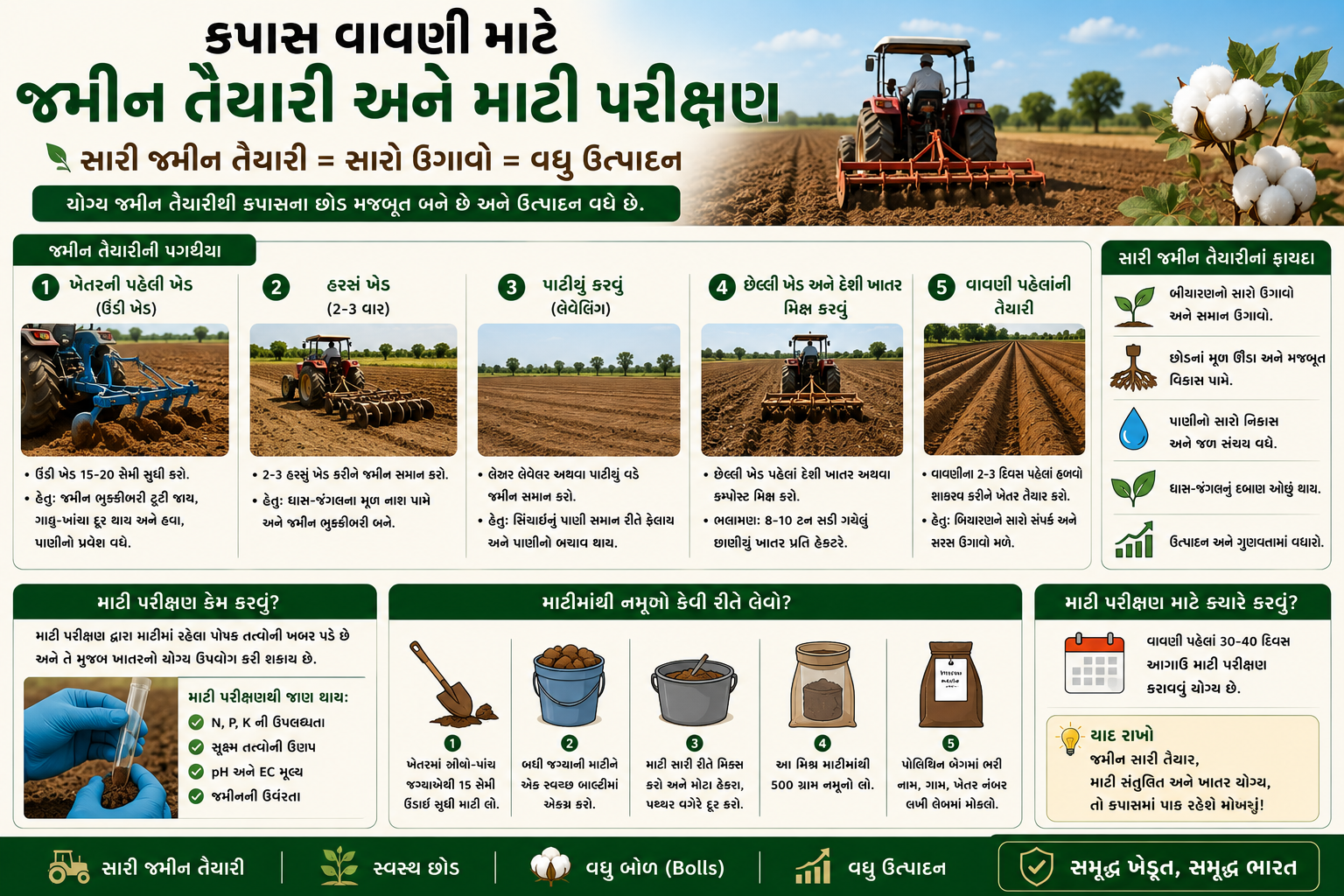
Proper land preparation is fundamental for a high-yielding cotton crop. Deep summer ploughing is essential to destroy fungal pathogens and insect pupae harboring in the soil. Carry out 2 to 3 harrowing sessions using a cultivator or blade harrow to improve the soil's moisture-retention capacity.
Conducting a mandatory Soil Test (Soil Testing) 15 to 20 days prior to sowing provides exact insights into existing nutrient deficiencies, saving considerable expenditure on unnecessary chemical fertilizers.
2. Importance of Primary Nutrients (NPK) in Cotton
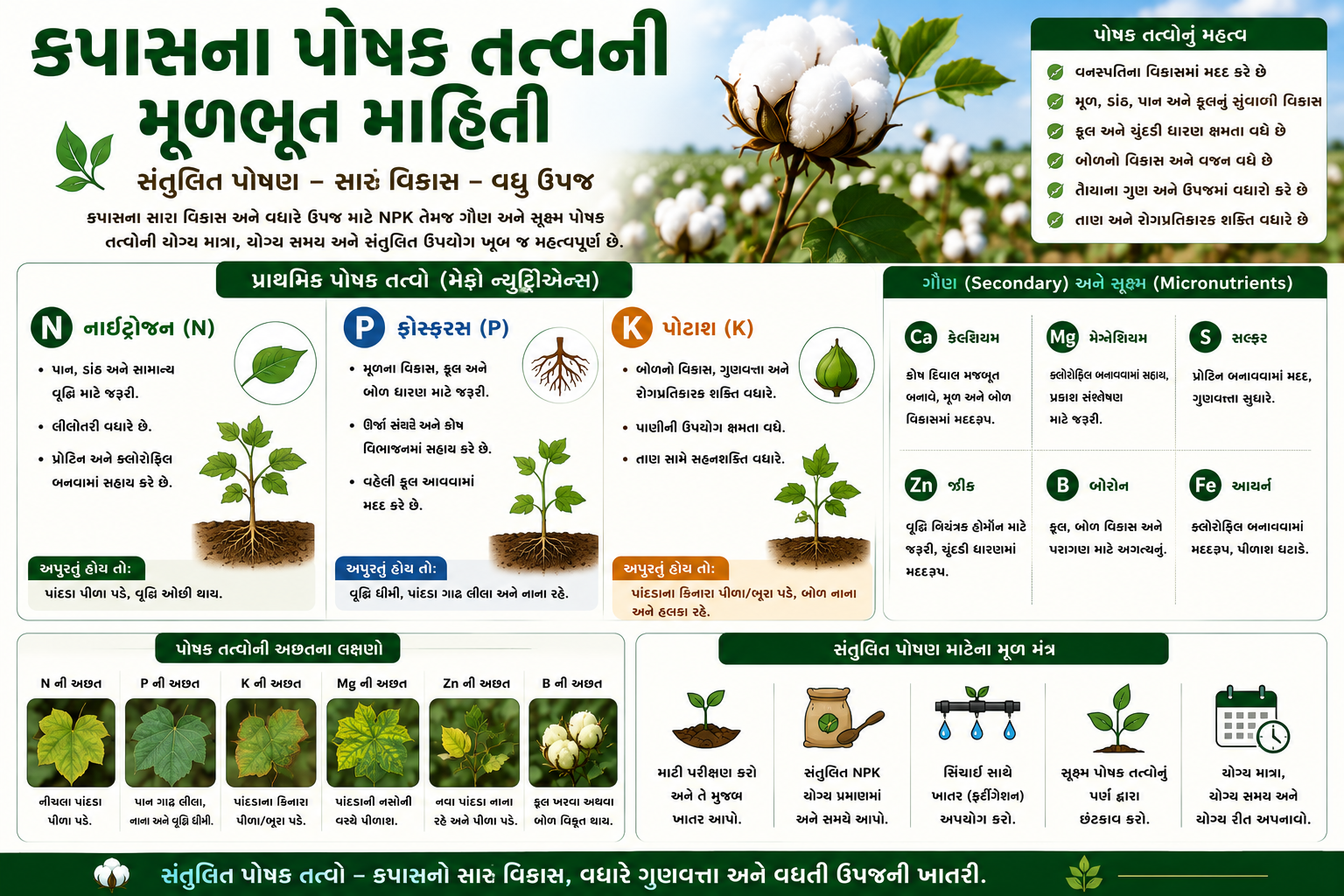
Nitrogen (N), Phosphorus (P), and Potash (K) play distinct and critical roles at different physiological stages of the cotton plant. Understand their primary functions and deficiency symptoms through the table below:
| Nutrient | Primary Function | Deficiency Symptoms |
|---|---|---|
| Nitrogen (N) | Promotes vegetative growth and maintains chlorophyll (green foliage). | Yellowing of older leaves and stunted plant growth. |
| Phosphorus (P) | Stimulates root system development and square (flower bud) formation. | Weak root growth, dark green or purplish discoloration of leaves. |
| Potash (K) | Enhances boll development, increases boll weight, and builds drought/wilt resistance. | Small boll size, reduced lint weight, and poor fiber luster. |
3. Ideal NPK Fertilizer Schedule for Cotton
Based on the soil conditions and agronomic recommendations in Gujarat and India, the standard recommended fertilizer dose for 1 Acre of cotton is 96 kg Nitrogen, 20 kg Phosphorus, and 20 kg Potash.
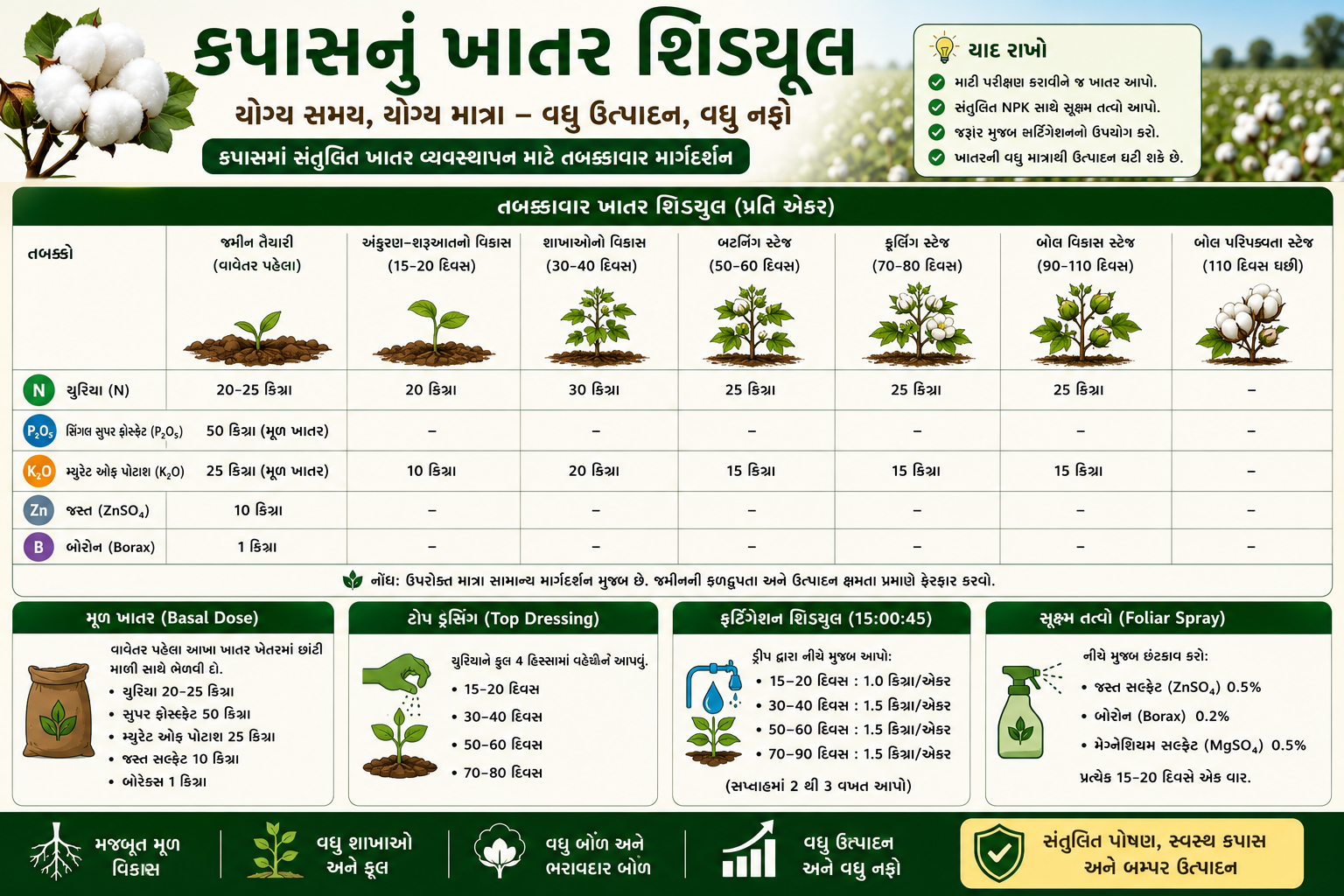
- At Sowing (Basal Dose): 1 bag DAP + 2 tractor trolleys of Farm Yard Manure (FYM) + 250g Mycorrhiza.
- 25 to 30 Days: 25 kg Urea + 5 kg Soil-grade Micronutrients.
- 50 to 60 Days (Flowering Stage): 30 kg Urea + 15 kg Muriate of Potash (MOP). This is the most critical stage.
- 75 to 85 Days (Boll Development): 25 kg Urea + 10 kg Calcium Nitrate.
4. Cotton Fertigation Schedule via Drip Irrigation
Applying water-soluble fertilizers directly to the root zone via drip irrigation saves fertilizer consumption by 30% while generating a direct yield increase of 20-30%.
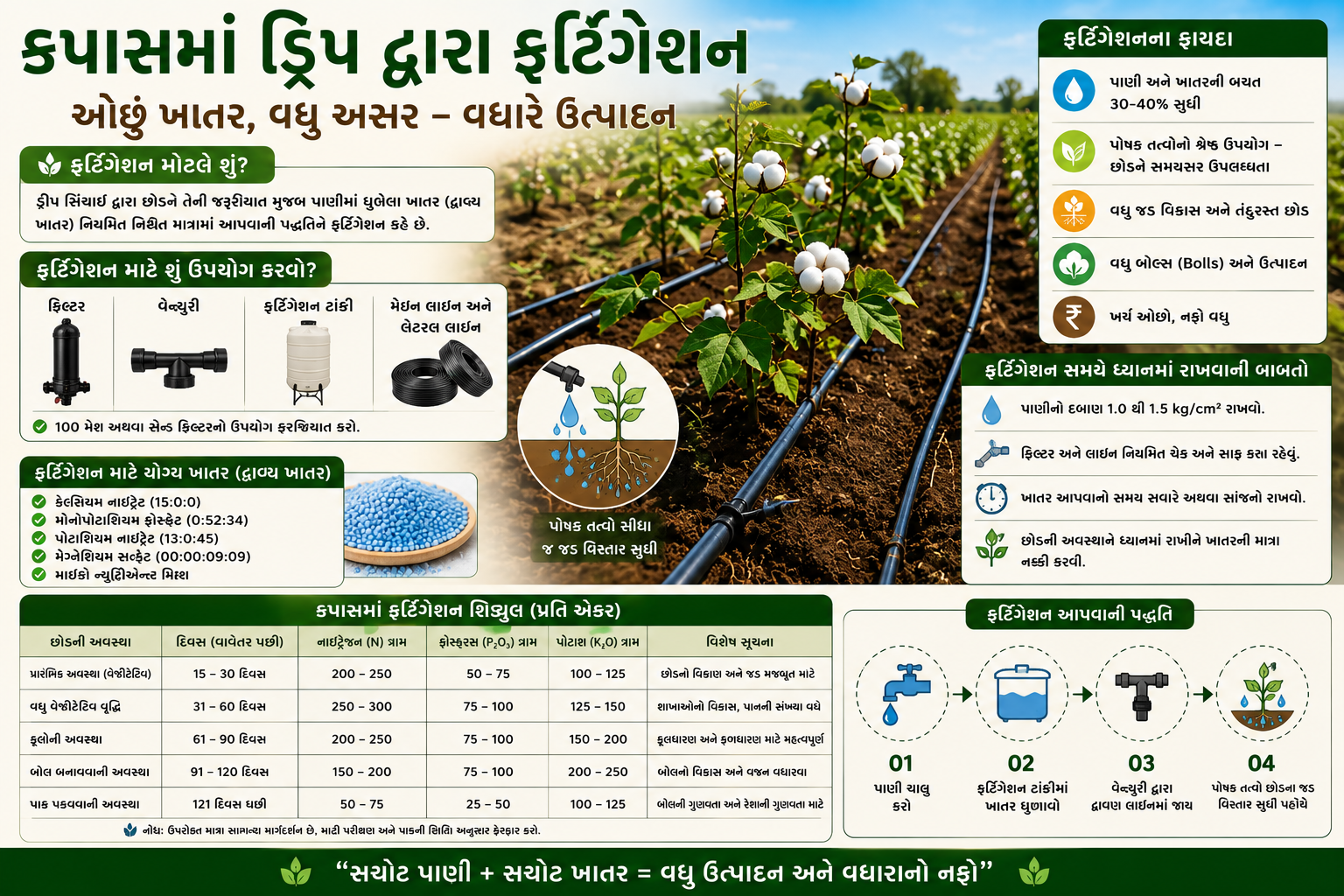
- 15 to 30 Days: Apply 3 kg of 19:19:19 water-soluble fertilizer per week.
- 40 to 60 Days (Flowering Stage): Apply 12:61:00 or 0:52:34 to maximize square formation and flowering.
- 70 to 90 Days: Apply 13:0:45 (Potassium Nitrate) to support boll retention.
- After 100 Days: Apply 0:0:50 (Sulphate of Potash) to significantly increase boll size, weight, and lint quality.
5. Nutrient Deficiency Symptoms & Remedies
In addition to primary NPK nutrients, cotton crops have a high demand for Zinc, Boron, and Magnesium.
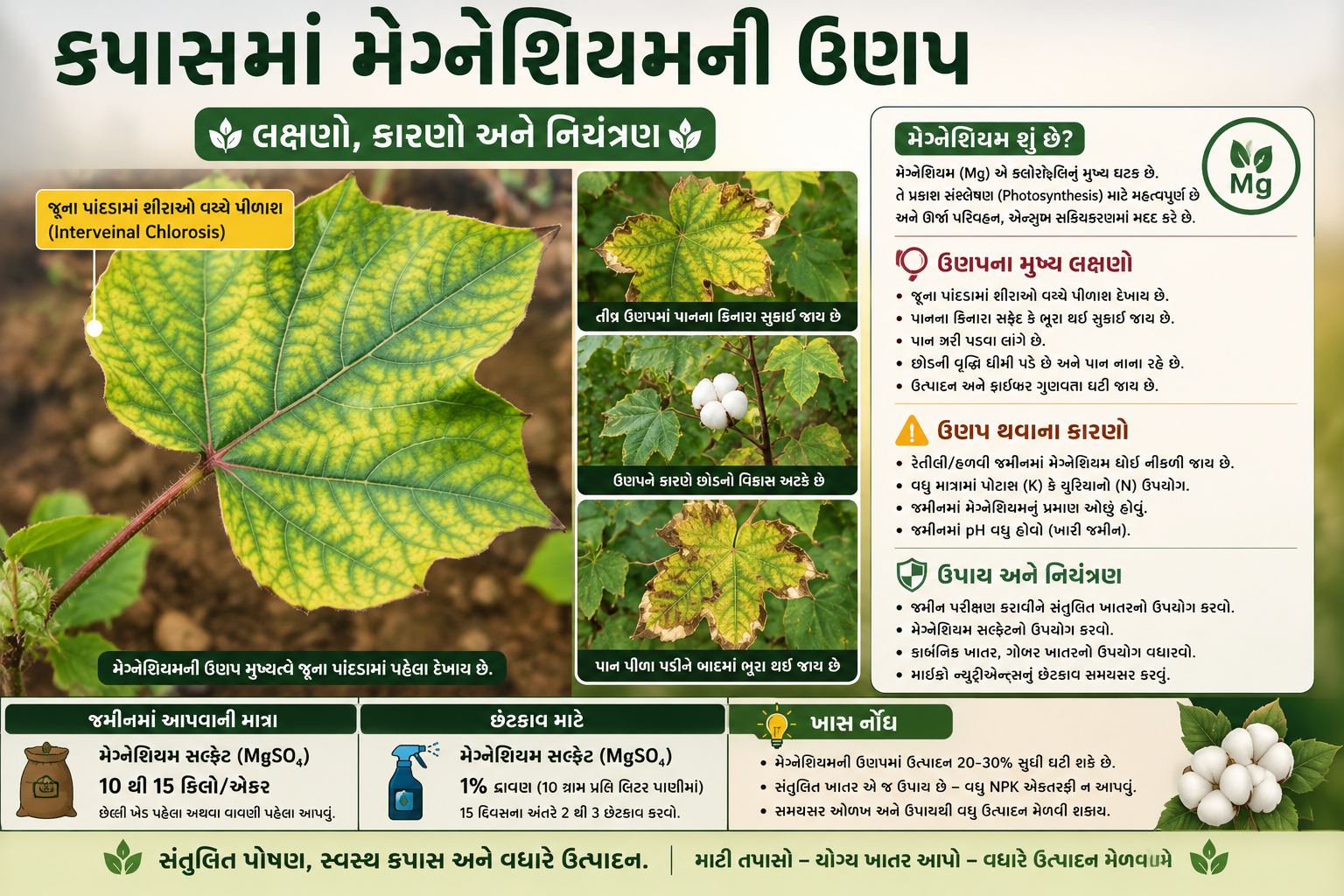
🔴 Reddening of Cotton Leaves (Magnesium Deficiency):Older leaves start turning red from the margins inward, eventually causing the entire leaf to turn crimson, dry out, and shed.
Remedy: Spray 100g of Magnesium Sulphate dissolved in 15 liters of water.
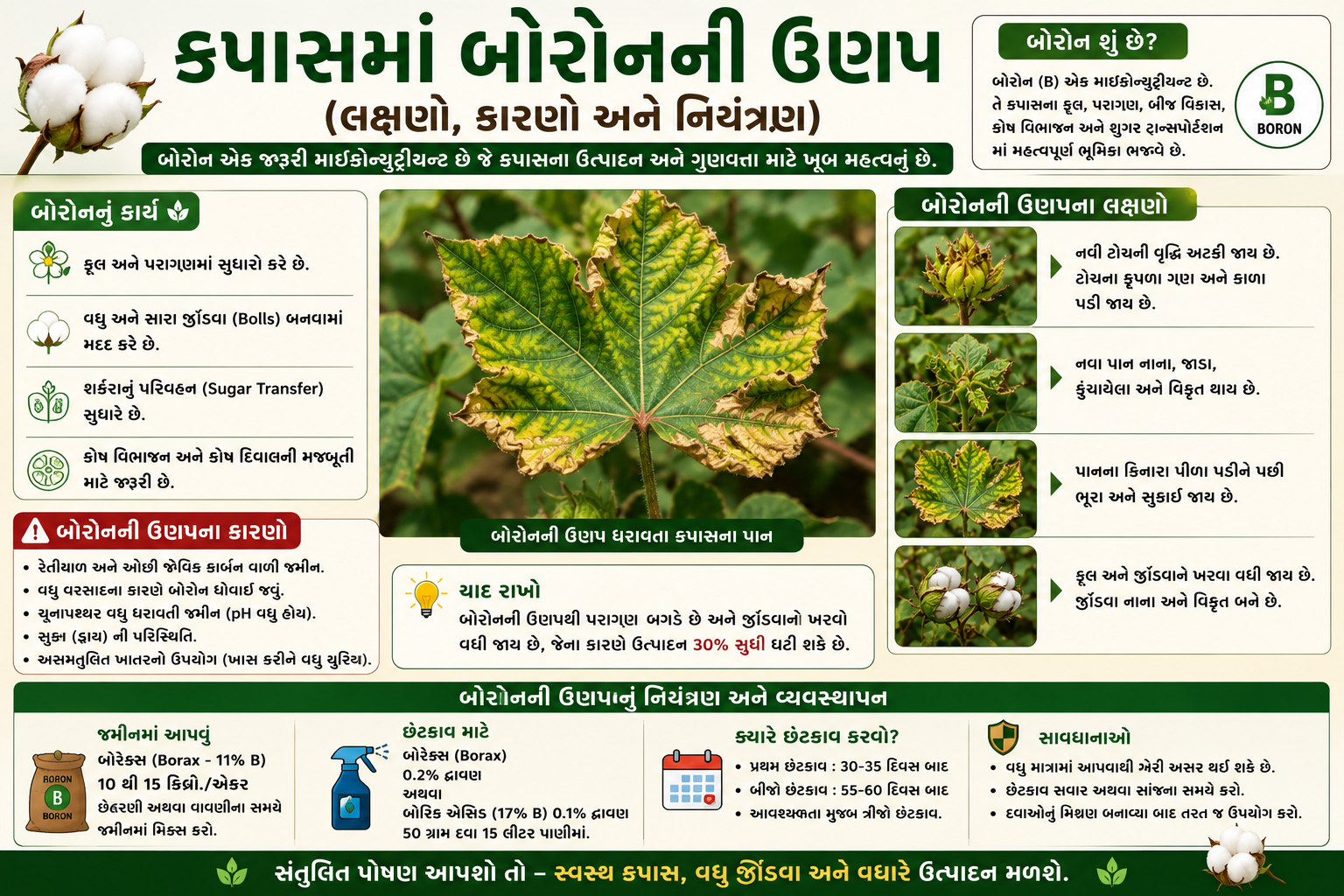
🍂 Square and Flower Shedding (Boron Deficiency):Flower buds (squares) turn yellow and shed in large numbers before developing into bolls.
Remedy: Apply a foliar spray of 20g Boron (Boron 20%) per 15-liter knapsack sprayer.
6. Smart Agronomic Tips to Boost Cotton Yield
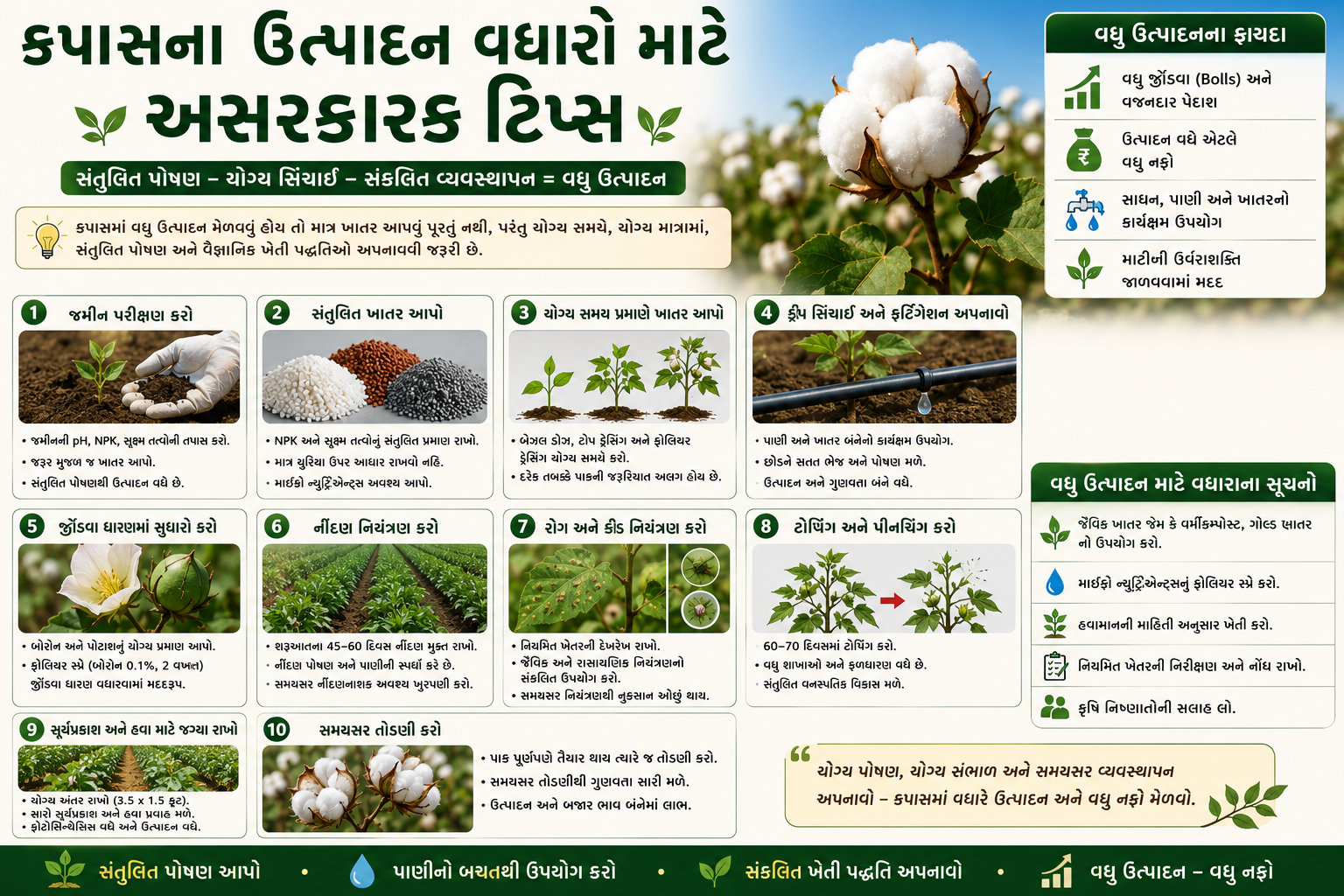
- Foliar Spray of Planofix: To minimize the natural dropping of squares and young bolls, apply a foliar spray of 4.5 ml Planofix mixed in 15 liters of water.
- Nipping (Top Removal): When the crop reaches 80-90 days of age, manually remove the apical growing tip (nipping) to restrict vegetative vertical growth and encourage lateral fruiting branch development.
7. Cost & Profit Calculation per Acre
By adopting scientific cultivation practices and an optimized fertigation schedule, farmers can achieve an average yield of 10 to 15 quintals of raw cotton (Kapas) per acre.
- Estimated Expenditure: Total input costs including seeds, fertilizers, plant protection chemicals, and labor average around ₹20,000 to ₹25,000 per acre.
- Gross Revenue: At prevailing market rates of ₹7,500 to ₹8,000 per quintal, total gross returns range between ₹75,000 and ₹1,20,000 per acre.
- Net Profit: Deducting all operational costs, a farmer can generate a net profit of ₹50,000 to ₹95,000 per acre.
8. Government Schemes & Subsidies
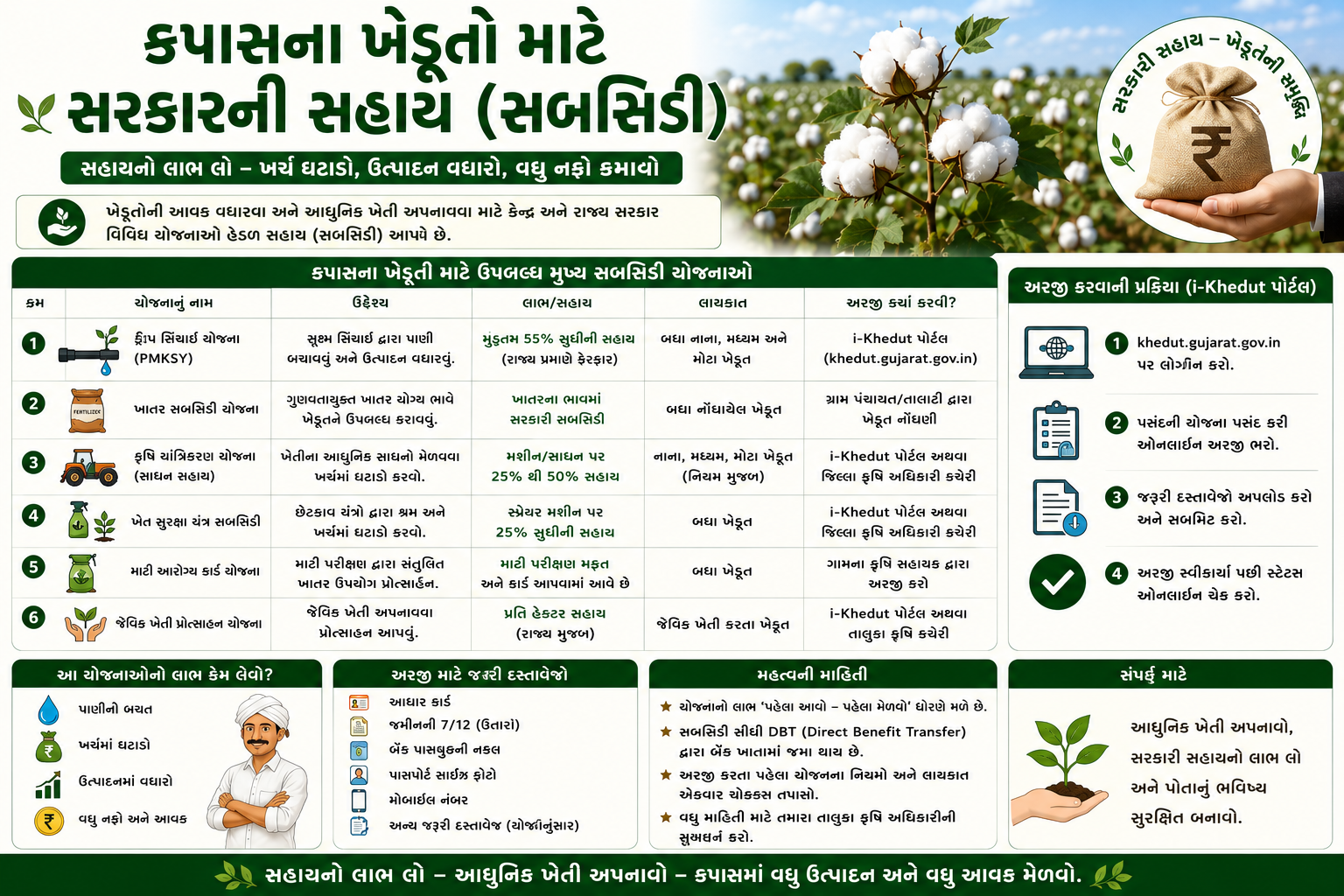
To reduce farming input costs, state governments (such as Gujarat via the I-Khedut Portal) and the Central Government offer various financial subsidies:
- Drip Irrigation Subsidy: Organizations like GGRC provide 70% to 90% financial assistance for installing drip irrigation systems.
- Tarpaulin and Spray Pumps: Subsidies are available for purchasing tarpaulins (to protect harvested crops during monsoons) and battery/engine-operated spray pumps.
- PM-Kisan Scheme: Eligible farmers receive ₹6,000 annually directly into their bank accounts under the Pradhan Mantri Kisan Samman Nidhi scheme.
❓ 9. Frequently Asked Questions (Cotton Fertilizer FAQs)
1. How much DAP should be applied per acre in cotton?
Applying 1 bag (50 kg) of Diammonium Phosphate (DAP) per acre as a basal dose during sowing is considered ideal.
2. How many split applications should Urea be divided into for cotton?
Urea should never be applied all at once. It must be divided into 3 equal split applications given at 30 days, 55 days, and 80 days after sowing.
3. What causes cotton leaves to turn red?
Leaf reddening is primarily caused by Magnesium deficiency. Soil moisture stress, waterlogging, or sudden temperature drops can also trigger this physiological disorder.
4. When is the best time to apply Boron in cotton?
The optimal time to apply a foliar spray of Boron is when square formation and flowering begin, typically around 55 to 60 days after sowing.
5. Which water-soluble fertilizers are most critical in drip fertigation?
In the early vegetative phase, 19:19:19 is vital for balanced growth, while 0:52:34 is the most critical formula during the peak flowering and square-retention stage.
6. What are the agronomic benefits of Potash in cotton?
Potash (Potassium) significantly increases boll weight, enhances lint strength and luster, and improves the plant's resistance to drought stress and wilt diseases.
7. What is the average fertilizer cost per acre for cotton?
The total expenditure on chemical fertilizers from basal dose to the final split application generally ranges from ₹3,500 to ₹4,500 per acre.
8. Which nutrient is considered the most critical for cotton crop yield?
While a balanced NPK ratio is necessary, Phosphorus is decisive for root and square establishment, whereas Potash is the most critical factor for final boll weight and fiber yield.
9. Can Jeevamrut be effectively used in cotton farming?
Yes, applying Jeevamrut every 15 to 20 days multiplies beneficial soil microbial populations, improves soil aeration, and can reduce chemical fertilizer dependency by up to 50%.
10. What chemical spray prevents square and flower shedding in cotton?
A combined foliar spray of 20g Boron (20%) and 4.5 ml Planofix dissolved in 15 liters of water effectively controls premature flower and square drop.
📚 References & Sources
- Indian Council of Agricultural Research (ICAR)
- Junagadh Agricultural University (JAU)
- Anand Agricultural University (AAU)
- Gujarat Agriculture Department (Krishi Bhavan)